Why Are Elbwood Fountain Pens So Expensive? Inside the Hamburg Workshop
What goes into a €2,050 fountain pen? At Elbwood’s Hamburg workshop, Frank Pressentin talks about design, materials, handwork, and the real cost of making a few hundred pens a year.


Why Are Elbwood Fountain Pens So Expensive? Inside the Hamburg Workshop
You can lock your phone and keep listening.
Follow My Pen — On the Road
Hamburg, October 14, 2026
In a photograph, you see a fountain pen: metal or wood, a gold nib, a fairly simple shape. Then you open the price. A thousand euros, two thousand, sometimes considerably more. Even as someone who collects expensive pens, I want to understand what goes into that figure.
That was the question I brought to Elbwood’s Hamburg workshop during my On the Road journey. I wanted to hear how the person who designs, makes, and sells the pen thinks about its price. Frank Pressentin was willing to talk about all of it: the work, the materials, retailers’ margins, and the worry of asking customers to pay more.
During our visit, Frank described the starting point of his range as roughly €1,000. For a more specific example, the silver Pocketmaster Hammerschlag from The Nine 2026 is listed at €2,050 in the official shop as I prepare this article. That is a price at which I want to know what I am paying for. Pocketmaster Hammerschlag — official product details
The answer gradually took shape around the way this small workshop operates. There is the development of a recognizable design, the preparation of materials, the finishing of each surface, and the cost of running a business spread across only a few hundred pens a year. Then there is the value a customer places on the work of this particular maker.
A Workshop Before There Were Pens
Frank welcomed us with coffee and cinnamon pastries. Around us were machines, tools, materials, and pens at different stages of completion. It was exactly the sort of place I had hoped to see on this trip.
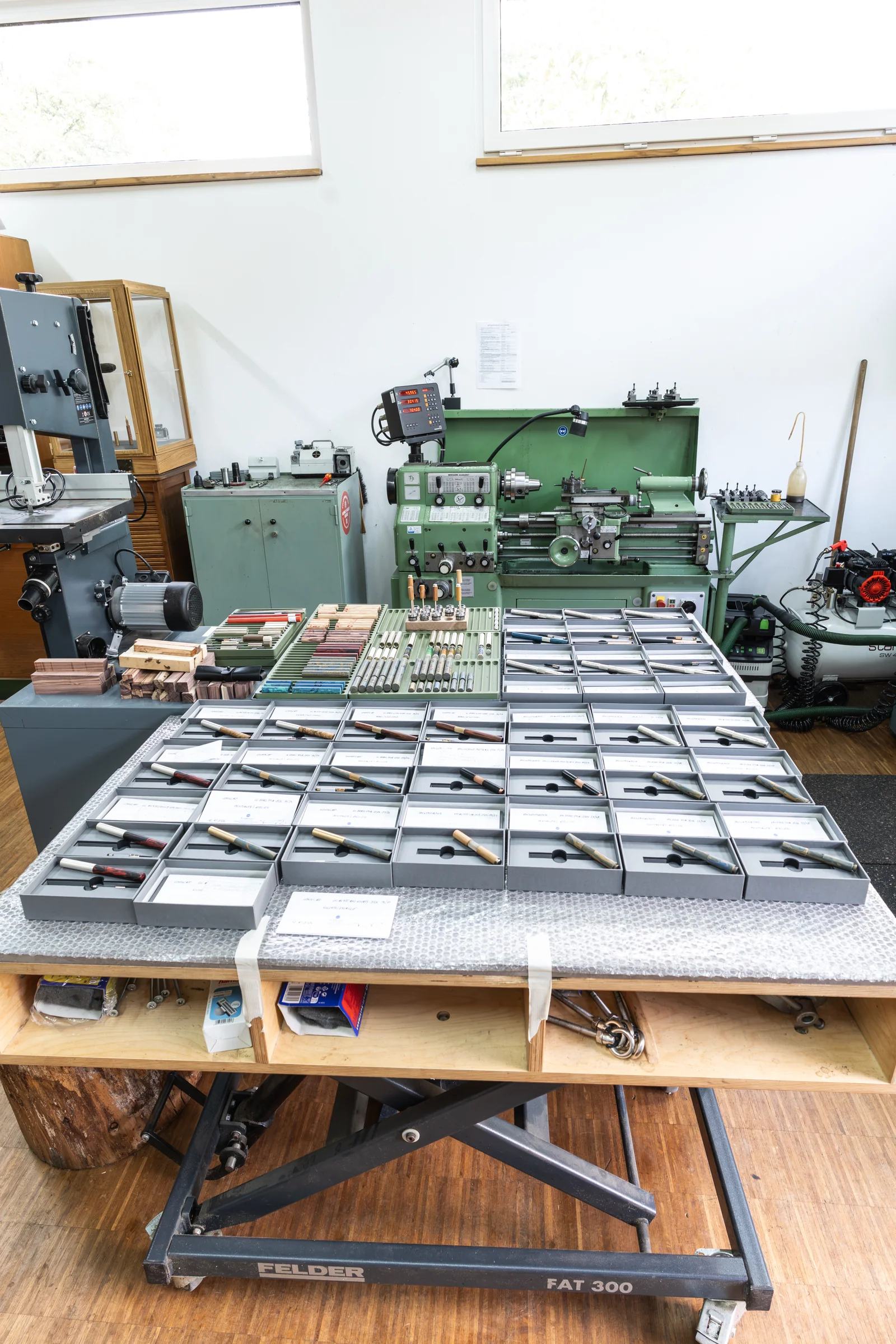
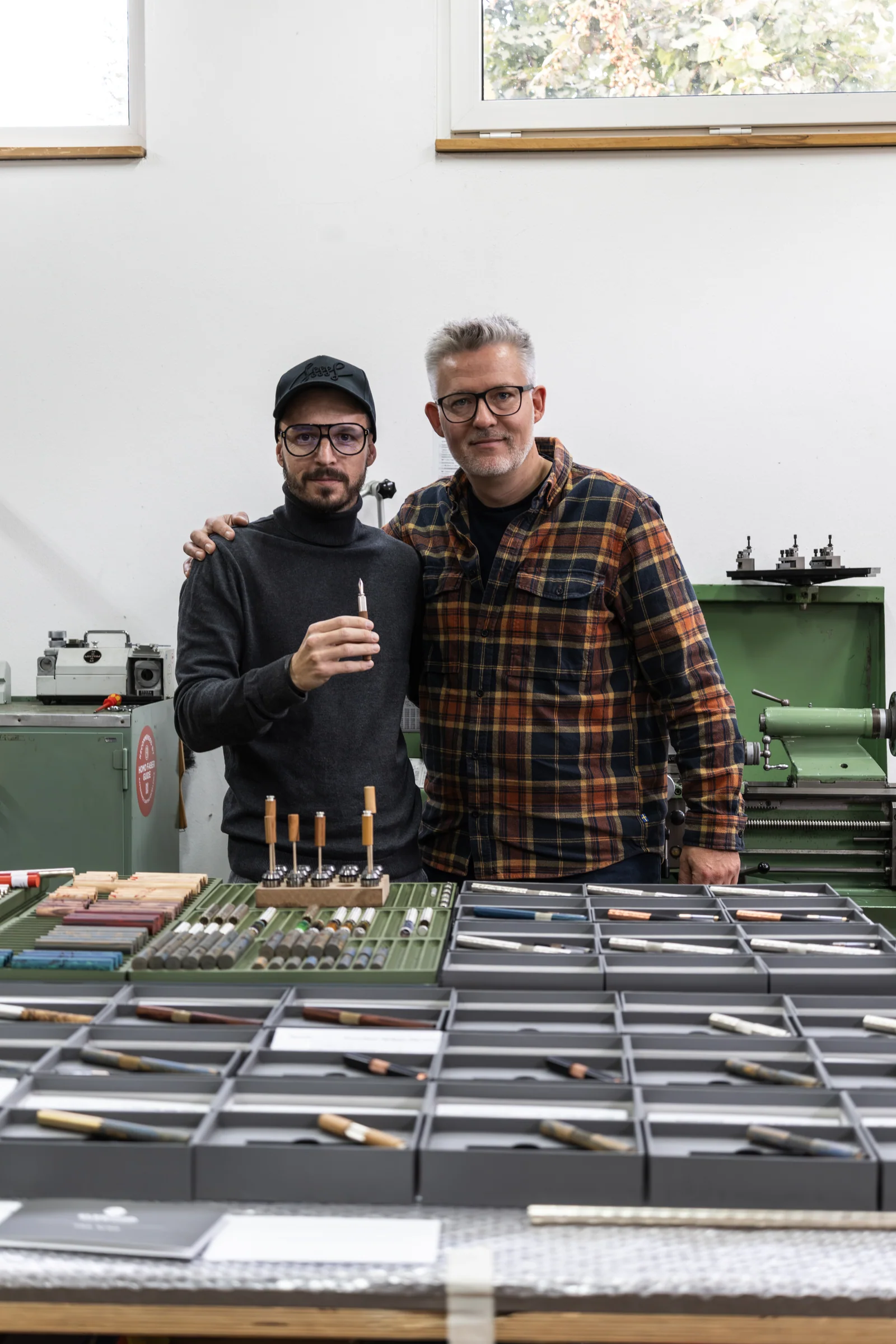
His relationship with the workshop began well before he decided to make fountain pens. He originally worked in the social sector. As he told us, the building, completed in 2016, was intended as a personal retreat: somewhere to work with his hands after days spent with people, spreadsheets, and screens.
He was building a wooden boat. As that project approached completion after years of work, he began wondering what would come next. Working with materials had become an important part of his life, and he wanted to keep doing it.
Boats, Hamburg, and captains’ logbooks helped lead him to pens. He knew the materials from boatbuilding, and writing had a natural place in the maritime story of his city. Gradually, that connection became a new direction.
I liked how openly he spoke about learning. He had not arrived with a comprehensive craft education that prepared him for every process. He sought out people who could explain specific techniques, building the knowledge he needed for his own projects. That journey is part of what we now see in a finished pen.
Three Years Behind a Simple Shape
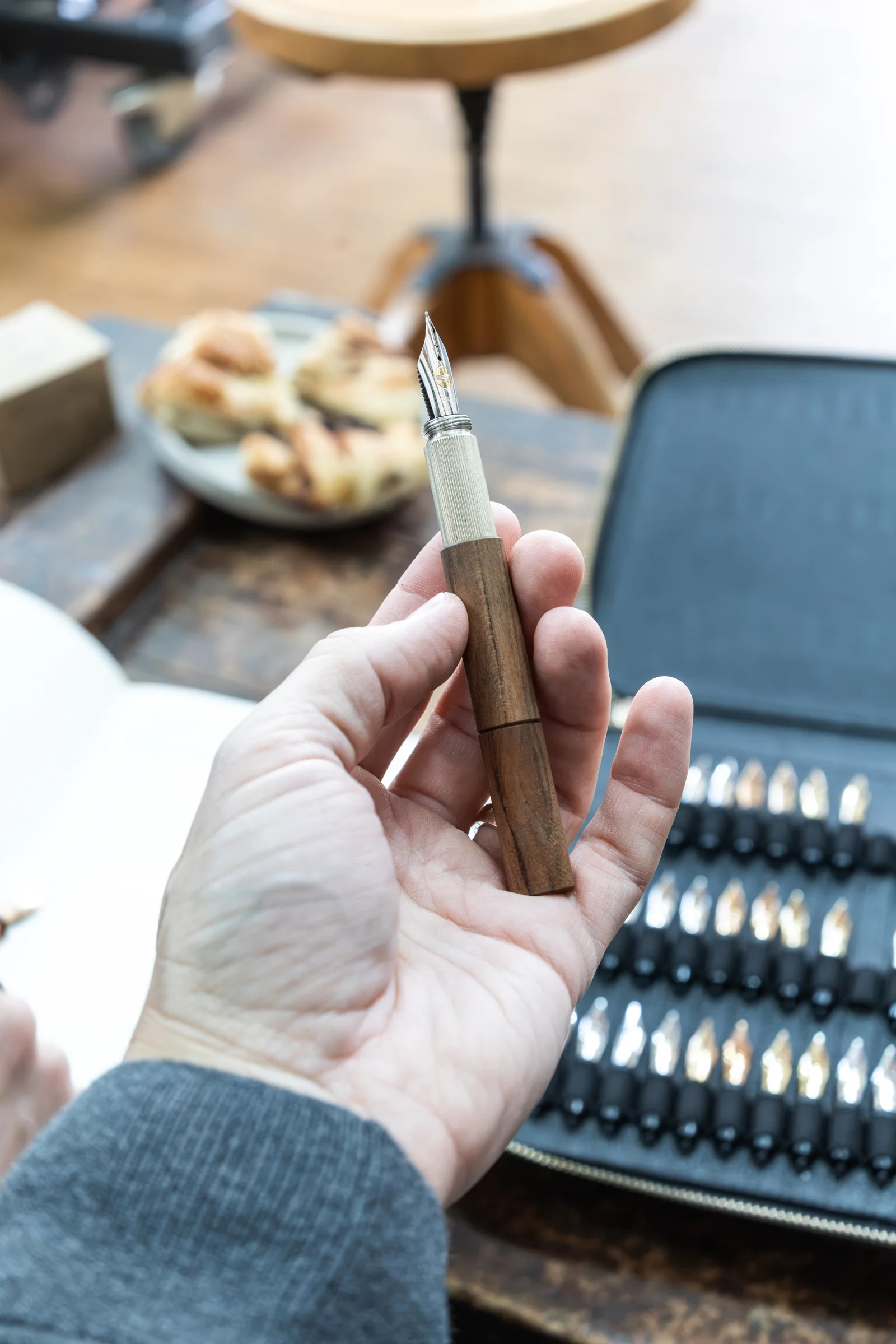
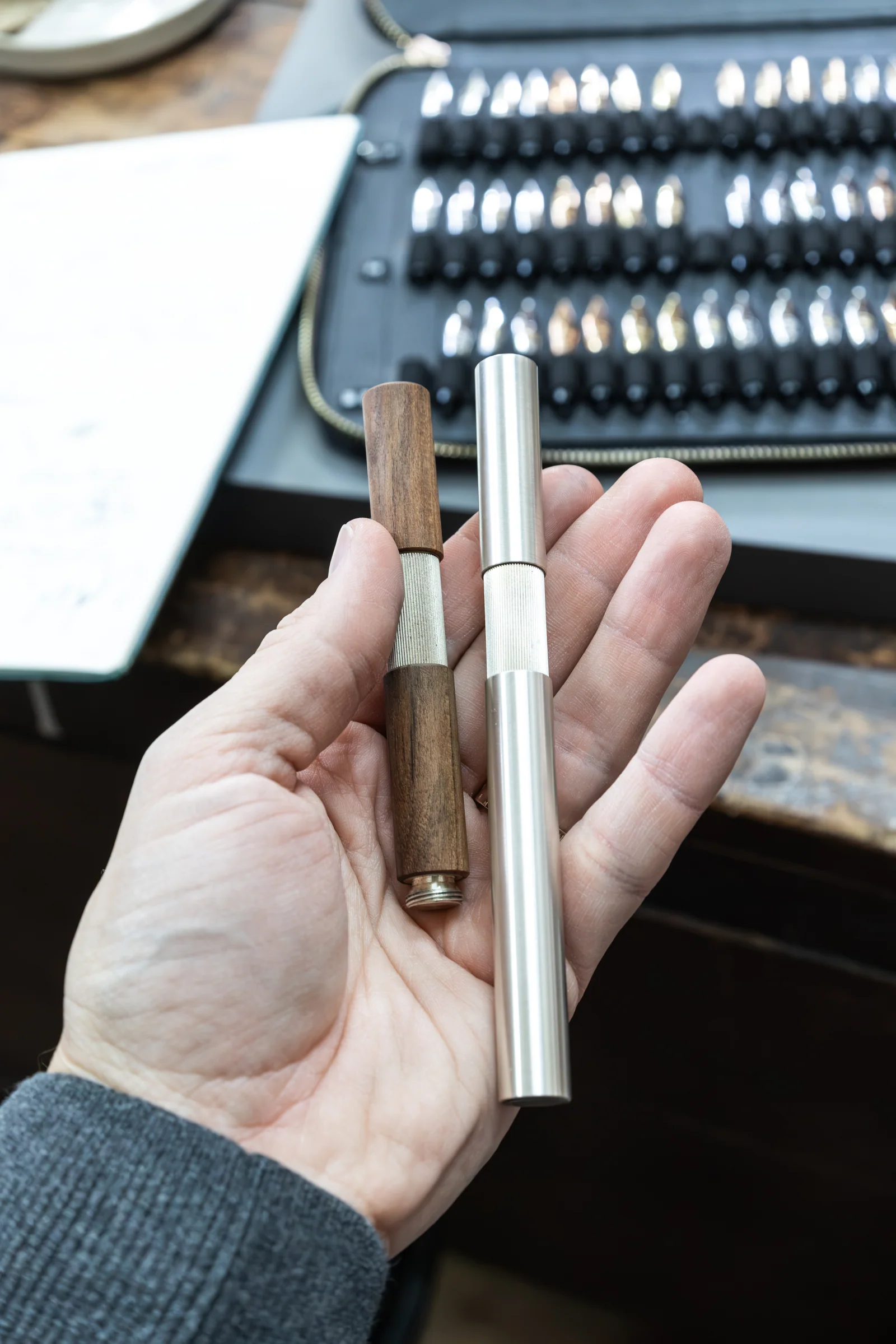
One of Frank’s starting points was a brass Kaweco Sport. He liked its weight and compact size. For his own pen, he wanted a recognizable shape that would also feel comfortable in a larger hand.
He explained that, when looking at the market, he was particularly interested in form. A color or an unusual material can attract attention immediately. He wanted his pen to retain its character even when those effects were taken away.
By his account, arriving at the Pocketmaster’s shape took about three years. There were experiments, ideas set aside, and later returns to them. Some solutions needed time before they made sense.
The result is a small pocket pen that extends for writing when its cap is screwed onto the back. On the finished object, that arrangement looks straightforward. You no longer see the earlier attempts or the decisions about proportion, grip, and balance.
This is one part of the price that a photograph cannot show. A simple final shape can have a long development history. That work has to be paid for across the pens eventually made; with a small production run, each pen carries a greater share.
There was also a connection with Phillip Landsiedel, whom we visited on the same trip. Frank told us that Phillip had spent around three weeks with him after leaving Montblanc. Phillip was struck by the simplicity of the construction. Frank’s point was how much development it had taken to reach it.
At the Lathe, with a Hammer in My Hand
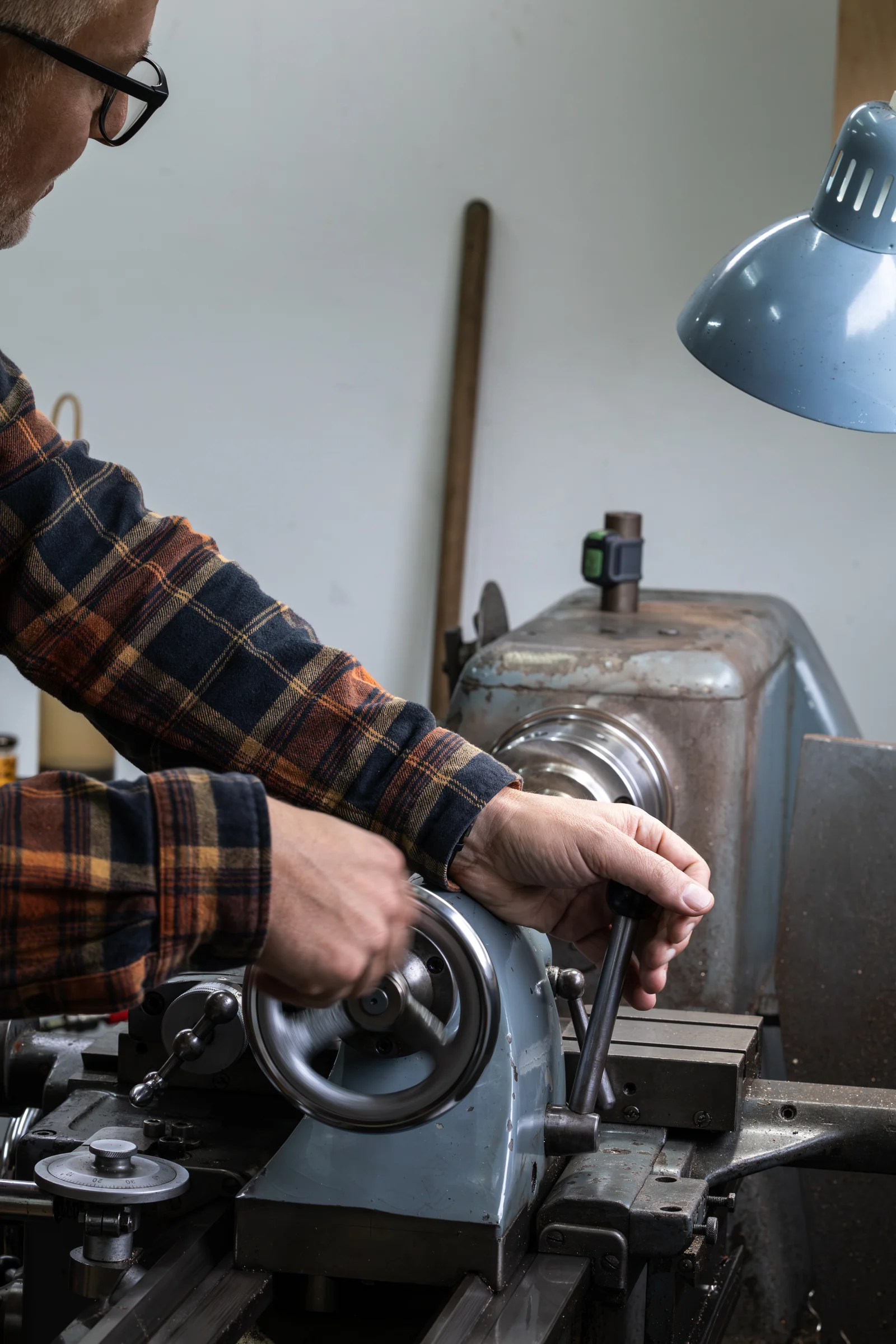
Elbwood uses lathes and precision machine tools. They are mechanical and manually controlled, with Frank directly guiding the work. The brand’s own description confirms that the components are machined from solid material on analog machines. Inside the Elbwood workshop
One lathe has an unusual history. Frank told us it dates from 1967 and previously belonged to a hospital in Rotterdam, where it was used to repair and make instruments. He sees that past as one reason for its condition: it had not spent its life running continuously in a factory.
He mentioned weights of around 650 and 850 kilograms for two machines in the workshop. The room feels personal and welcoming, but those figures quickly remind you how much equipment stands behind a small finished pen.
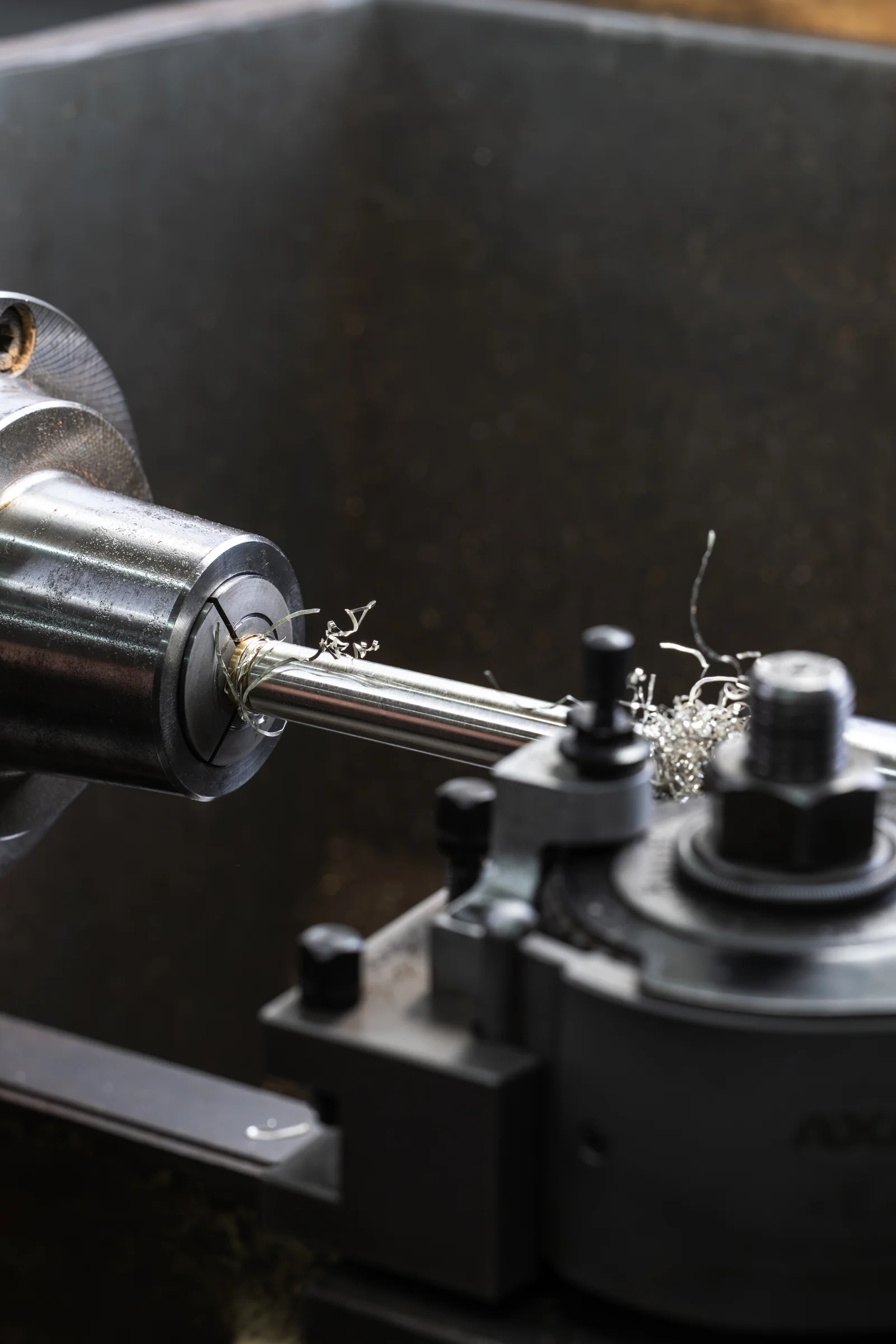
During our visit, he showed us silver being machined. Long, bright shavings curled away from the metal. They looked almost decorative, although Frank also warned us about their sharp edges. He collects them for recycling, allowing the precious metal removed by the lathe to return to use.
The hammered finish made the work even easier to understand. Frank picked up a hammer and demonstrated how the texture develops on silver. Then I took the hammer myself.
A single strike is easy. Across a whole surface, you start watching for untouched areas, the overlap of the marks, and the overall effect. Frank showed us how the two faces of the hammer leave different impressions. You pause, look at the metal from another angle, and carry on. After a while, you have a much clearer sense of the patience in a finished pen.
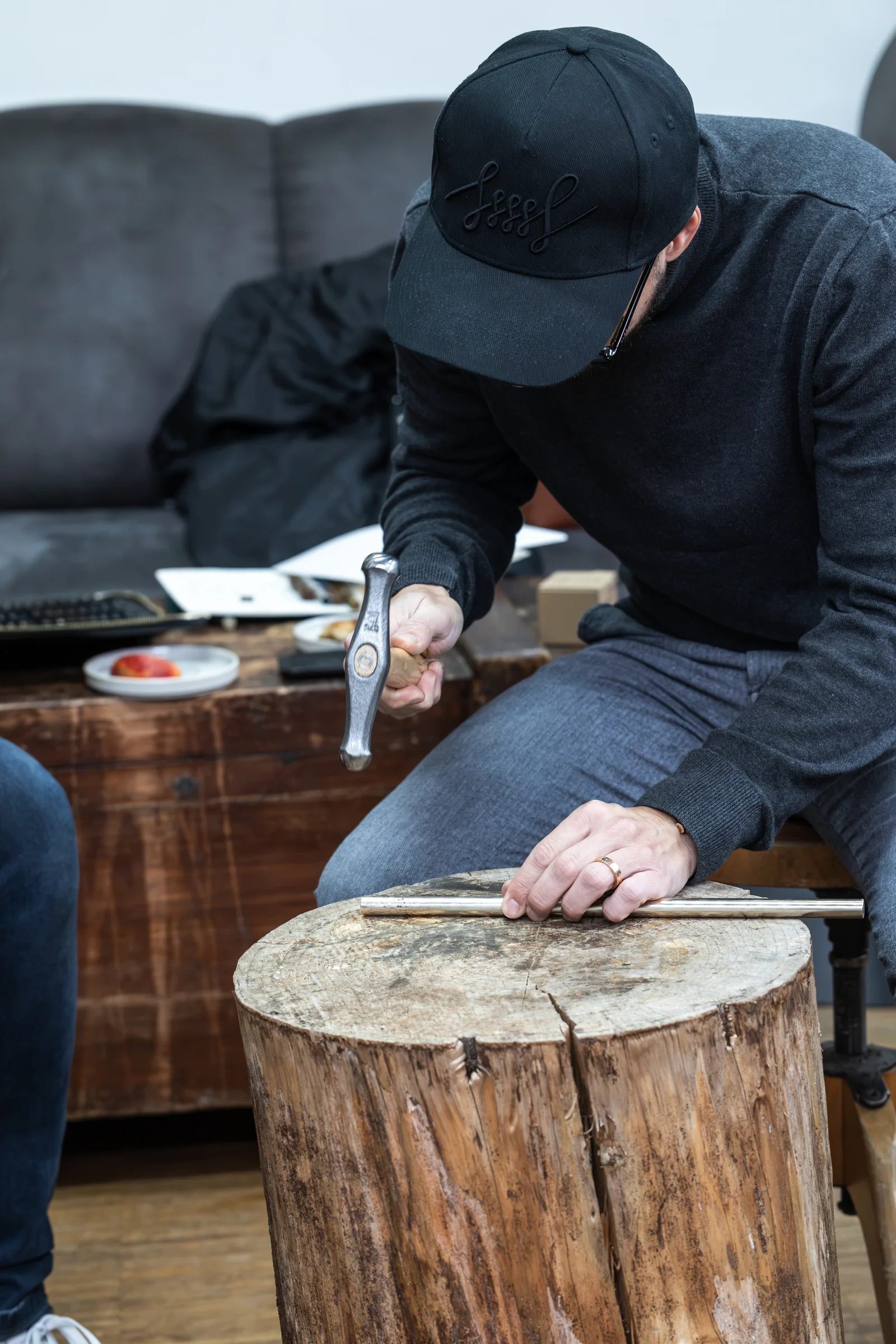
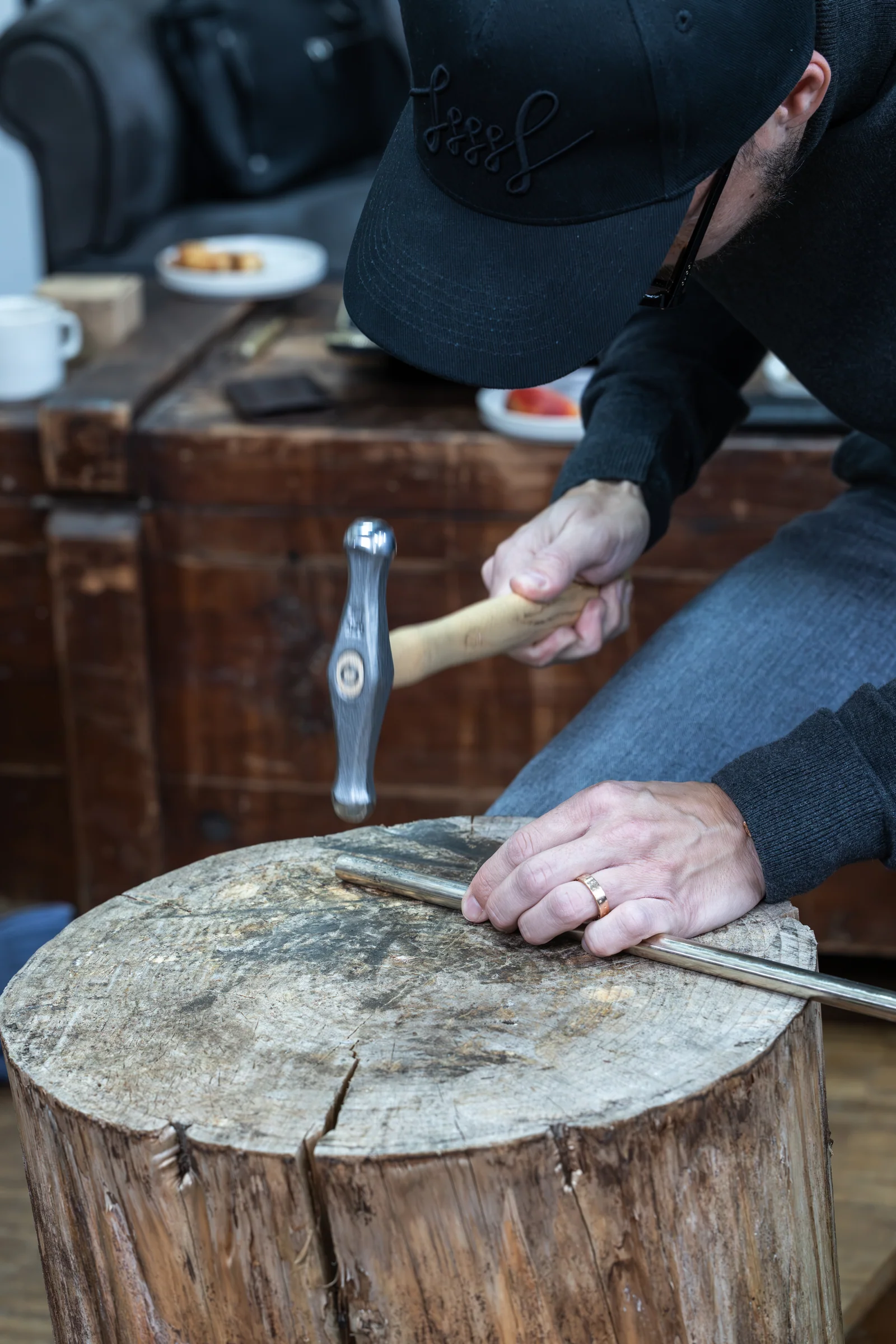
Frank said his surface looks slightly different from Maurice’s. Ours looked different again. Each person’s hand, rhythm, and eye leave small variations in the material.
On a product page, the result can be described with one word: hammered. In the workshop, you see the work behind that word. For me, this was one of the most convincing parts of the visit.
The silver Pocketmaster Hammerschlag has a barrel, cap, and grip section made from solid 935 silver. Elbwood lists its weight at approximately 77 grams. Both the weight and the texture are therefore an important part of experiencing this particular pen. Silver Pocketmaster specifications
The Material Costs More Than Its Purchase Price


On the table, we could compare wooden and metal versions. Even with a similar shape, the material changed the character of the pen considerably. With wood, the contact with the surface itself is a large part of the appeal.
I even noticed the smell of individual pens. I told Frank that you could almost smell the handwork in them. A photograph can show color and shape; the scent, temperature, and feel of the material need to be experienced in person.
Frank wants to preserve that natural contact with wood. As he explained it, this means long drying times, careful machining, and accepting some uncertainty. A problem in the material can appear at the final cut. By then, a great deal of work may have gone into a piece that will never become a finished pen.
The price of the wooden blank is therefore only the beginning. Preparation, storage, machining, and the time spent on unsuccessful pieces all belong in the calculation. The customer sees the outcome of a successful process. The workshop also has to absorb the attempts that did not work.
Mokume-gane offers another example. It is a layered metal with a pattern reminiscent of wood grain. Elbwood uses combinations that include silver and Japanese metal alloys, with the material itself made by a specialist craftsperson. Elbwood’s mokume-gane Shortcap
Frank explained how much work is already present in such a blank before he starts machining it. If something goes wrong, he risks losing another person’s work as well as his own. That is a very concrete reason why certain material combinations move the price considerably higher.
There was also a custom ebonite for The Penmaker’s Atelier edition. Its colors were developed with Schönberger Ebonite Manufaktur in Hitzacker, drawing on the colors of Frank’s workshop. Frank took part in making the material from which the pens would later emerge. The Penmaker’s Atelier at Elbwood
He told us that the idea of using the workshop’s colors came from his wife. I like how specific that is: an object can carry the colors of the place where it was made.
The ebonite brought an unexpected story, too. Frank showed us a film of the production process and said that the finished video had moved the production manager to tears. According to Frank, it meant a great deal to him that someone had seen beauty in his demanding everyday work and shown it to other people.
We also talked about patina. Copper and silver change through use and contact with their surroundings, and Frank takes that into account in his pens. I mentioned my own experience with silver: on some pens, I notice the surface changing very quickly, sometimes by the following day. When choosing that material, I know I am choosing something that will continue to change.
The workshop’s colors even extend to ink. Machine Grey refers to the gray-blue shades of the old lathes. Frank showed us a color somewhere between gray, black, and blue, explaining how difficult it had been to get close to what he had in mind. I enjoyed that connection between a pen, the place where it is made, and the ink used with it. Machine Grey in the Elbwood collection
A Few Hundred Pens Have to Support a Whole Business
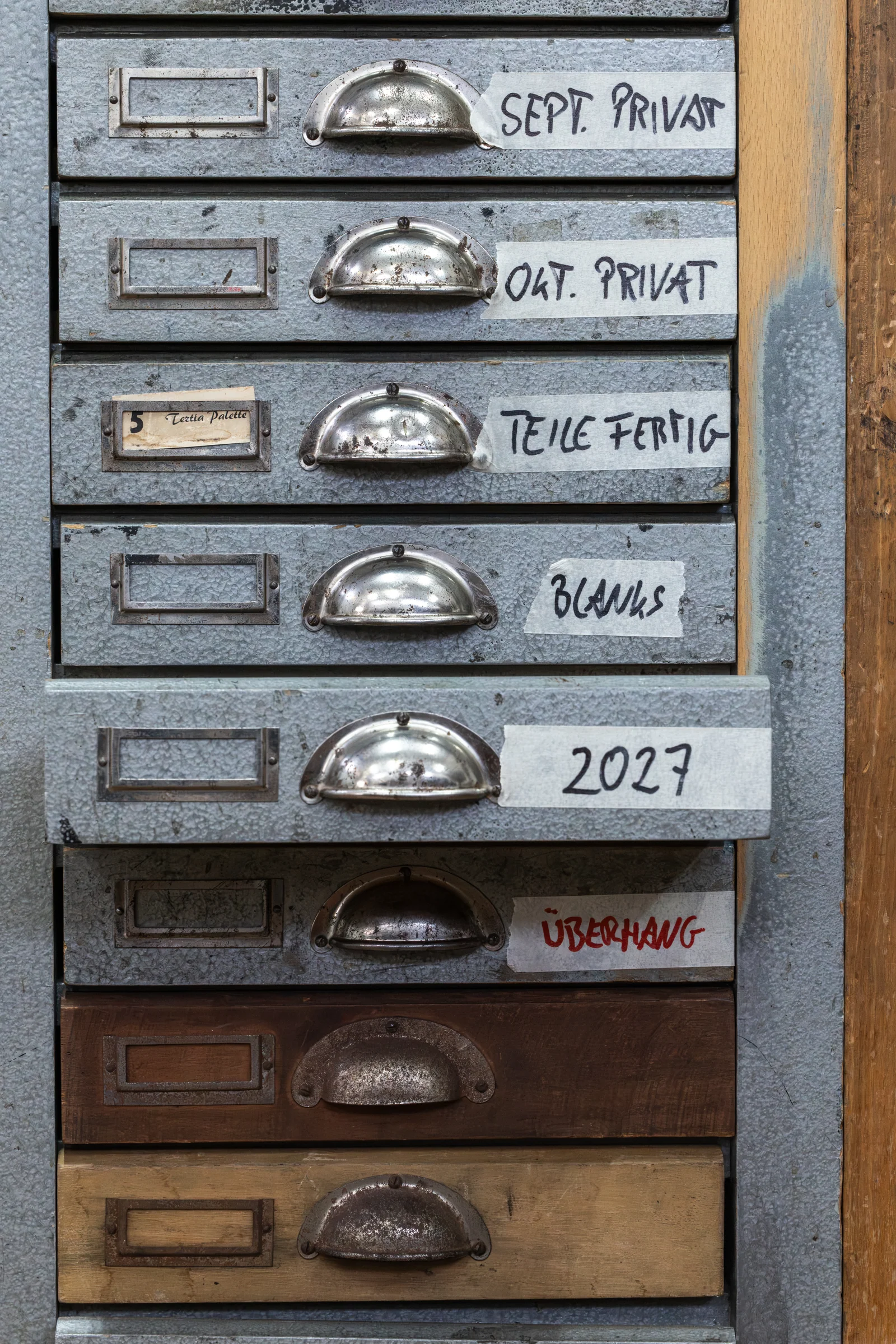
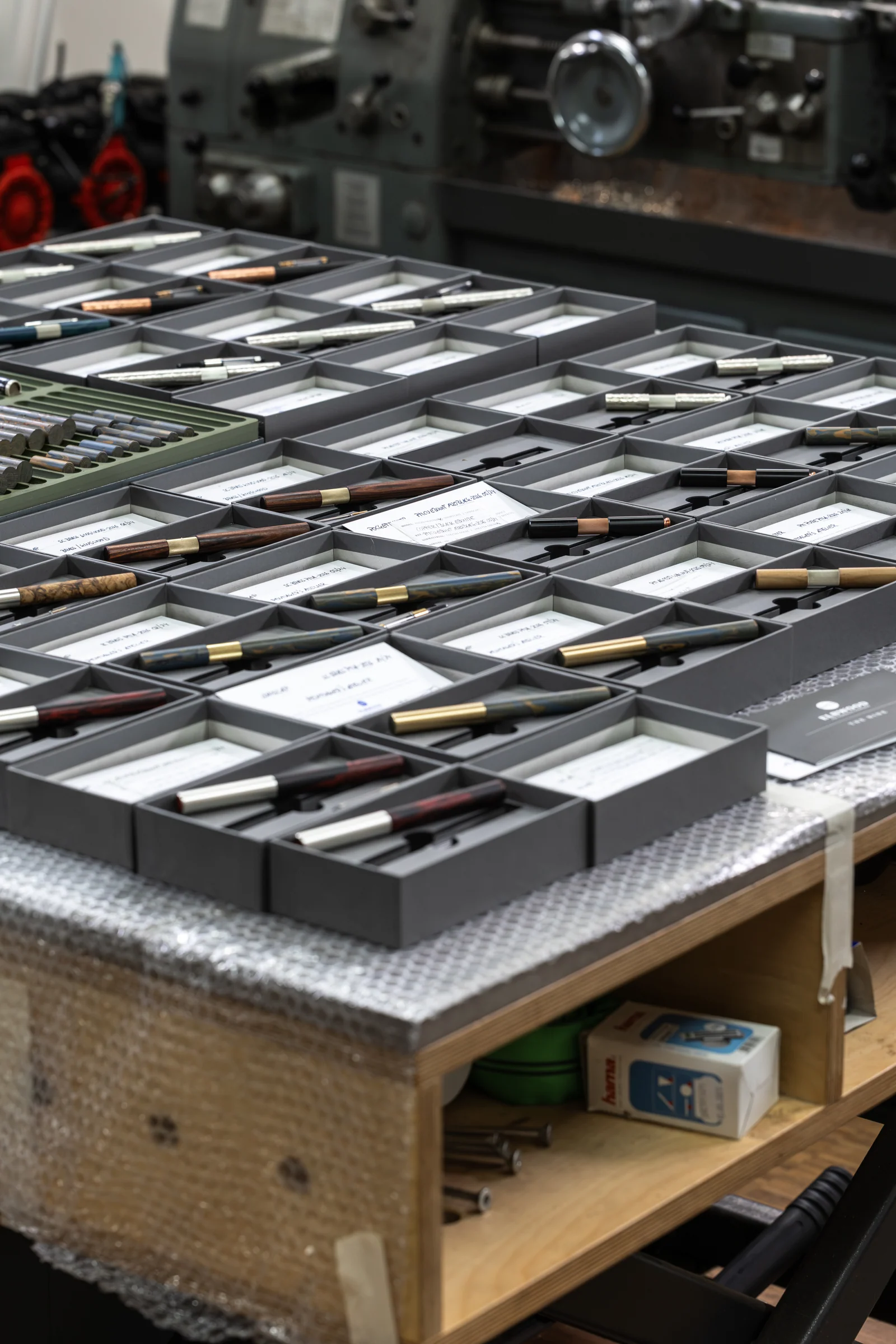
When I asked how long it takes to make a pen, Frank naturally began by distinguishing between models. Some, he said, can be made in a day. Others need at least two. Material preparation, drying, and the work surrounding production complicate any simple answer.
The annual figures gave me a clearer picture. Working alone, he said he had made around 150 pens a year. With his colleague Maurice, that had risen to approximately 330.
That was the scale of Elbwood during our visit. Two people make the pens. This small annual output has to pay for materials, labor, the workshop, and everything needed to get those pens into customers’ hands.
Frank thought that, together, they might reach around 400 pieces. He also felt that this would create a level of pressure he did not want to sustain. He spoke about his own experience of making mistakes when trying to finish and dispatch work too quickly.
He has therefore moved gradually from many fully individual commissions toward planned editions. Similar steps can be grouped together, making time easier to organize. This is how he is finding efficiencies within the kind of workshop he wants to preserve.
He had considered CNC production as well. Computer-controlled machining can offer precision and repeatability, but Frank chose direct involvement at the machine and a small output. It is a creative and business decision, with consequences for the cost of each pen.
That does not mean he avoids digital tools. He told us that he uses AI for translations, organizing his thoughts, and developing ideas. Time saved on the work surrounding the brand matters in a small business. His choice of manually controlled machines is about how he wants to make the pens themselves.
Learning to Charge for Everything Around the Pen
The most candid part of our conversation came when I asked how he had arrived at his prices.
At first, Frank said, he calculated materials and working hours and applied a conventional multiplier. Over time, he realized how much that calculation had missed. A website, photographs, videos, communication, and finding customers all take time and money. While he is doing those things, another pen is not being made.
A significant moment came at Papeterie Berlin. He had gone to introduce his pens and learned that his proposed price left insufficient room for a retailer.
A shop has to pay for premises, staff, advice, and customer care. If it is to represent an independent maker over time, the arrangement has to work financially. After the retailer’s share, the maker still needs enough to pay for production and keep the workshop running.
Frank described how the shop’s owner encouraged him to consider his pens in the context of the work involved, their materials, and the small number being made. Prices rose, and he gradually became more comfortable with the category in which he was placing his work.
This story mattered to me because it explains a part of craft pricing that is less often discussed. A sustainable price has to pay for the business between sales, too. If the calculation stops at materials and hours at the lathe, a substantial part of the work remains unpaid.
Frank also places value on his own design. He develops the shapes, chooses the materials, and decides how the finished object should look and feel. That value cannot be calculated simply from the weight of its metal. The customer has to decide whether this particular work means enough to them to justify the asking price.
And What About the Nib?
With an expensive fountain pen, it is natural to pay close attention to the nib. Frank was straightforward about this as well: he does not manufacture his own.
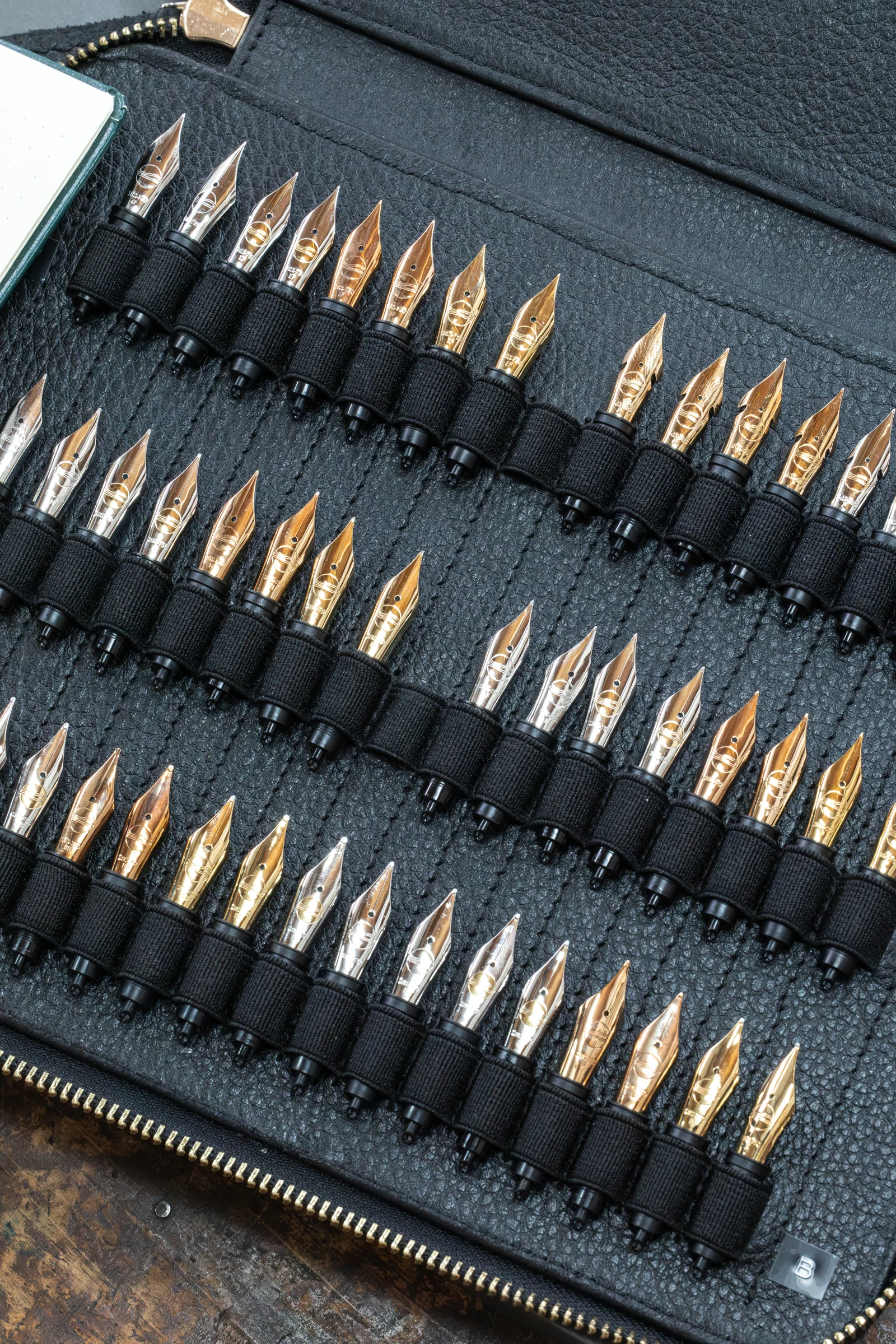
Elbwood currently specifies JoWo number 6 nibs, with 18-karat gold as standard and a flexible 14-karat gold option. The company says it checks and fine-tunes the nibs before dispatch. Elbwood’s nib information
In a follow-up to our visit, Frank told me that he plans to introduce larger JoWo No. 8 nibs in 18-karat gold soon. His long-term dream is to make his own nibs. He has already taken the first steps in that direction, learning some of the techniques from fellow penmaker Koji of H.Works during a visit to Japan.
During our visit, we tried different widths and papers. Frank showed us a modified extra-fine nib, and we discussed how the choice relates to the way someone writes. For small entries in my journal, I often return to fine nibs. For larger, more expressive writing, I also enjoy B or BB. I want to know how a pen behaves in my own hand.
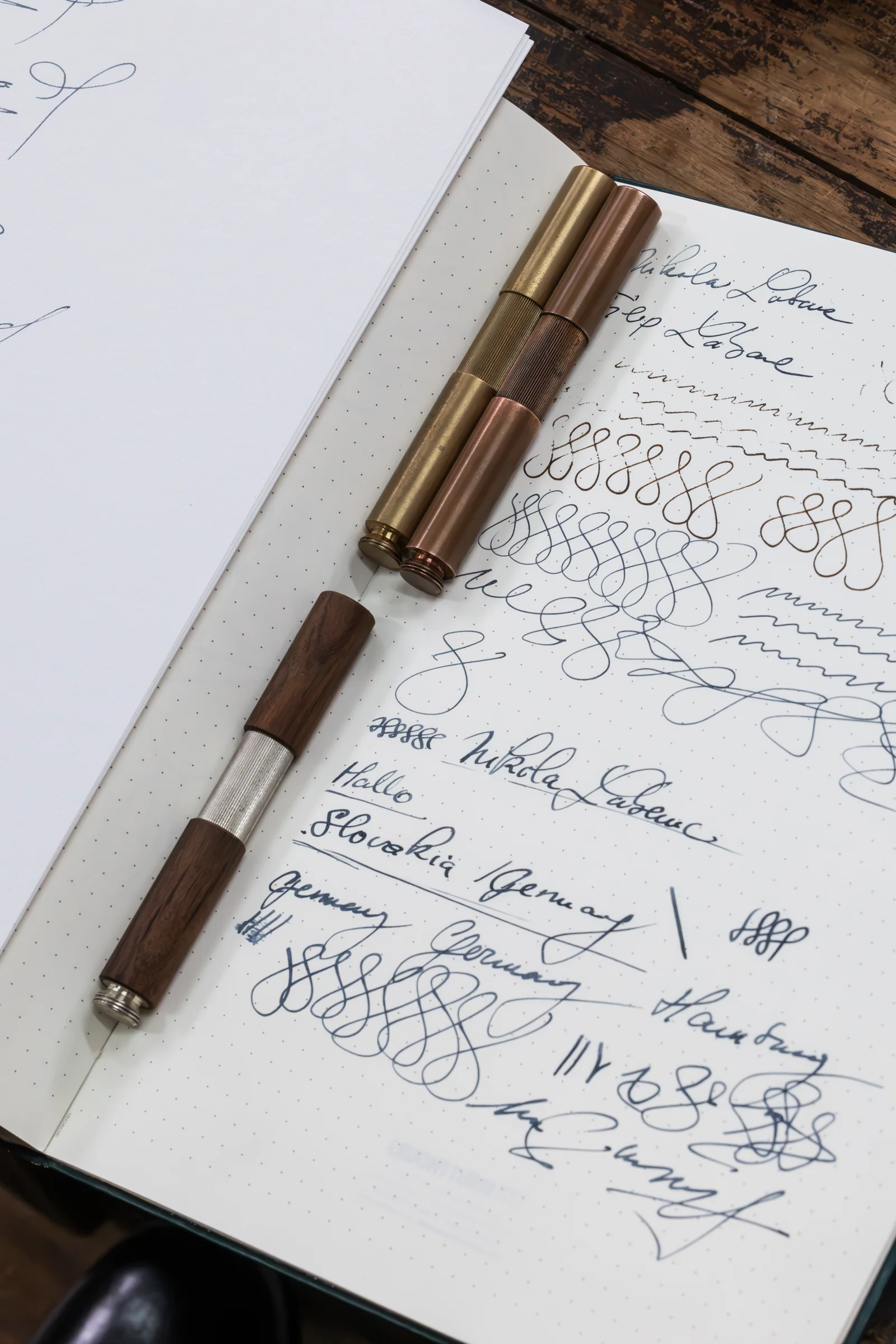
Frank had begun with bespoke commissions, allowing customers to choose materials much as they might choose fabric for a suit. He recalled starting prices of €1,850. Visitors to his showroom, however, often wanted an immediately available gift at around €300–500. For a time, he offered more accessible versions with steel nibs.
Later, he decided to concentrate on gold nibs and a more expensive range. He admitted that returning to a starting price of about €1,000 had cost him sleepless nights. He did not know how customers would respond.
For a buyer, the implication is clear: much of an Elbwood’s price belongs to the complete object, its design, and the way it is made. When comparing pens, I need to distinguish the experience of the nib from the value I place on the body, material, surface, and work of a particular maker. A higher price alone cannot tell me which nib will suit me best.
When we asked what Frank uses himself, he showed us his workshop pieces. They have small imperfections that kept them out of the shop, but he finds them too beautiful to put aside. They still serve him for everyday writing. Even pens he would not send to a customer have a place in his own workshop.
Small Editions, and a Record of What Was Made
For the silver Pocketmaster Hammerschlag, the published limit is 36 pieces per year. Each has a reference identifying its place in that year’s edition. That gives a collector more useful information than the word limited alone. The Nine 2026 — Pocketmaster edition
Frank told us that his 2026 edition had sold out by June. At the time of our visit, he was still completing orders and already had orders for the following year. With this way of working, a pen can be sold well before it leaves the workshop.
There was an amusing story behind The Nine. Frank liked the arrangement of nine pens in three groups. When he sent the photographs to Pen World, he recalled being asked where the nine core values were. He liked that idea enough to sit down over a weekend and put his principles into words. The arrangement of the collection became a way of explaining his approach.
He is also building a record of his work. He showed us Elbwood — A Closer Look 2026, a book produced in 26 hand-bound copies. It includes the collection, selected bespoke projects, stories, and a catalogue of the work. Elbwood — A Closer Look 2026
Frank prepared the book largely as a thank-you to longstanding collectors and partners. During our visit, he said that three copies had been offered in the shop at €1,250. Maurice, who also makes pens with him, created its graphic design.
For a collector, that documentation has value. It helps place an individual object within a maker’s work, understand its material, and see its relationship to other pieces. With a small brand, it is interesting to watch that record take shape.
I would still choose a pen because I want to own and use it. I would not treat its limited production or a rise in the price of a later collection as a promise about what my own pen might sell for in the future.
What a Day in the Workshop Can Teach You
Frank also told us about his former showroom. He opened it early, while balancing his previous work, family life, and the beginning of his penmaking career. He later closed it, and there was a period when he wondered whether to continue at all.
According to his account, a television documentary and an article by a pen enthusiast helped bring renewed interest. In November 2021, he relaunched the website and online shop. Gradually, he also realized that the workshop could be an excellent place to meet customers.
One visitor particularly appreciated seeing where the pens were made. That helped Frank recognize the value of the experience for his customers. After our own visit, I understood it. A workshop can provide concrete answers to questions left open by a product photograph.
His courses work in a similar way. Under his guidance, a visitor can make a brass or copper pen. In his experience, it can be completed in a day, but making one independently requires much more knowledge. Under supervision, the process is divided into manageable steps. The decisions and experience of the person beside you remain a substantial part of the result.
Maurice was a good example. He already had experience with a lathe, graphic design, and leatherwork. Even so, Frank said it took around six months for him to become confident making an entire pen independently. A day’s experience and command of a craft represent very different levels of knowledge.
I also liked Frank’s willingness to pass on what he knows. He has tried to advise people interested in making pens and help them find their own direction, while asking them to respect his designs. Many visitors come for the shared experience: a father and son, a parent and daughter, or a couple spending a day together.
At prices running into thousands of euros, the relationship after purchase also matters. Elbwood states that material and manufacturing defects are covered by a lifetime guarantee with free repair. Damage through misuse or external causes is handled as a paid service. Elbwood’s repair and guarantee terms
Frank acknowledged that, as more pens enter use, the organization of that care needs to develop too. Personal contact is a strength of a small workshop, and it is a commitment that continues long after a parcel has been sent.
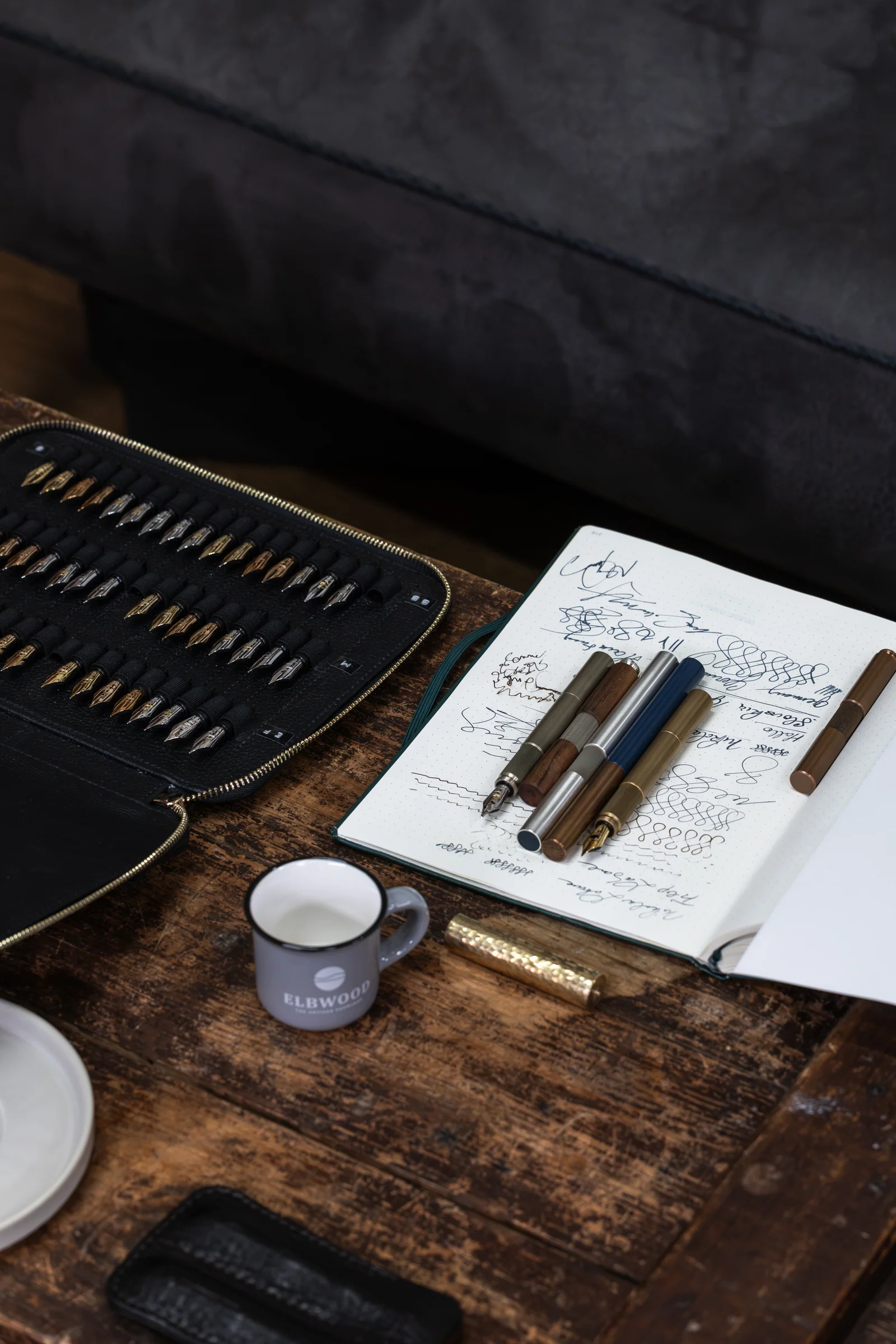
At the end of our visit, I handed him my travel journal with the question I had brought on this journey: What do you refuse to rush in life, and why?
After a conversation about drying wood, developing shapes, and patiently hammering silver, it felt especially appropriate here.
So, Why Are Elbwood Pens So Expensive?
After the visit, I had a much more concrete answer. The price brings together an original design, work with demanding materials, manual finishing, a small output, and the cost of keeping the whole business running. It also reflects the value a buyer finds in a particular maker’s work and its origins.
Understanding those things does not make the purchase automatic. I left without an Elbwood. There are other pens on my wishlist that currently have a higher priority. But Elbwood interests me, and if I were to buy one, I would already have narrowed the choice.

For materials, I would be deciding between two possibilities. The first is silver with a hand-hammered surface. Having tried the process myself, I would be especially drawn to the idea of a pen incorporating the part I had worked on. If that were possible, it might be the one I would choose: a physical memory of this visit, carried in the pen itself.
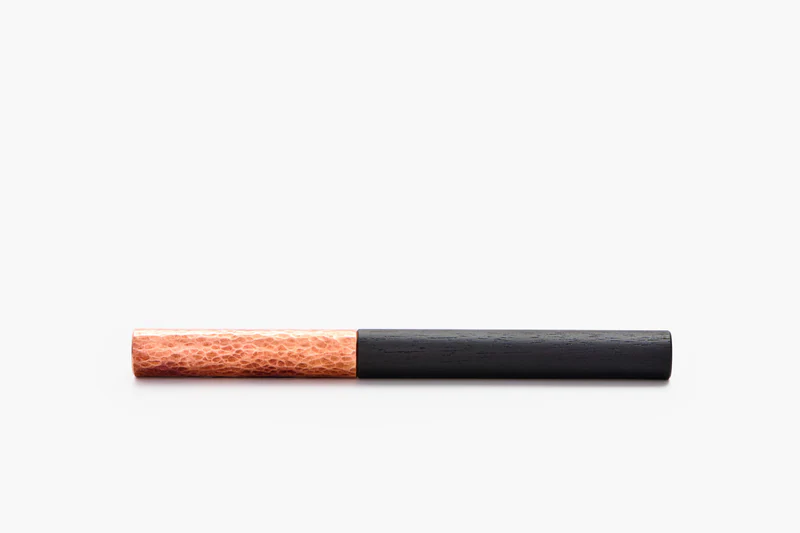
The other candidate is the Longcap Ebony & Copper Hammered, combining Macassar ebony with hand-hammered copper. The relationship between wood and metal is what particularly attracts me to these pens. Longcap Ebony & Copper Hammered
For size, I would be certain: the Longcap. If I chose hammered silver, I would first speak with Frank about the possibilities in that format. I do not own a pocket pen. I am simply a person who likes large pens.
The Journey Continues with Mercedes-Benz
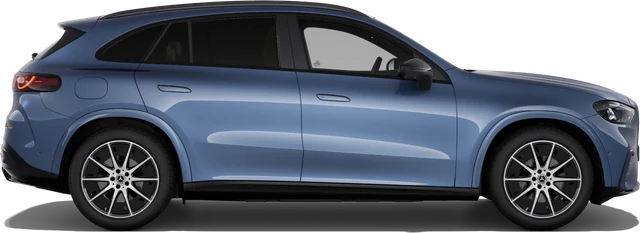
Our blue Mercedes-Benz GLC 400 4MATIC carried us between the stops on this On the Road journey. In Hamburg, the questions had become very specific: how a nib can be adjusted to a hand, and what it takes to make a pen in a small workshop. Each visit gave me another reason to look more closely at the objects I use.
For the full story of the trip and the people behind it, read On the Road — The Stories Behind the Pens.
Read next
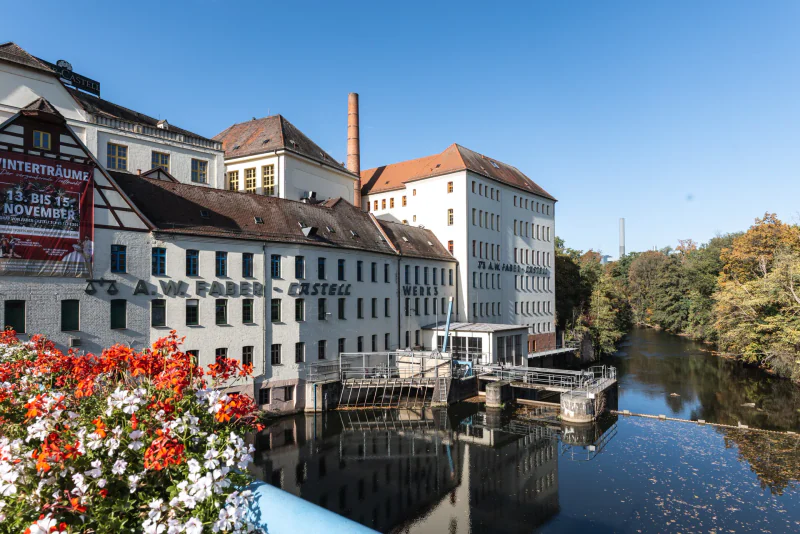
Inside Faber-Castell in Stein: The Surprising Life of a Pencil
A factory visit in Stein, from graphite and clay to eight coats of lacquer, an eraser without glue and a fountain pen made from 84 pieces of wood.
Read article
A Journey to the Heart of Montblanc: The Montblanc Haus and Pen Manufacture in Hamburg
Montblanc, my favorite brand, symbolizes the pinnacle of craftsmanship and luxury in writing instruments. The moment Montblanc Haus was unveiled in 2021, it beckoned me irresistibly. This year, my long-awaited visit materialized, extending beyond the allure of Montblanc Haus to the very birthplace of its pens. My tour, meticulously planned since last year, coincided with..
Read article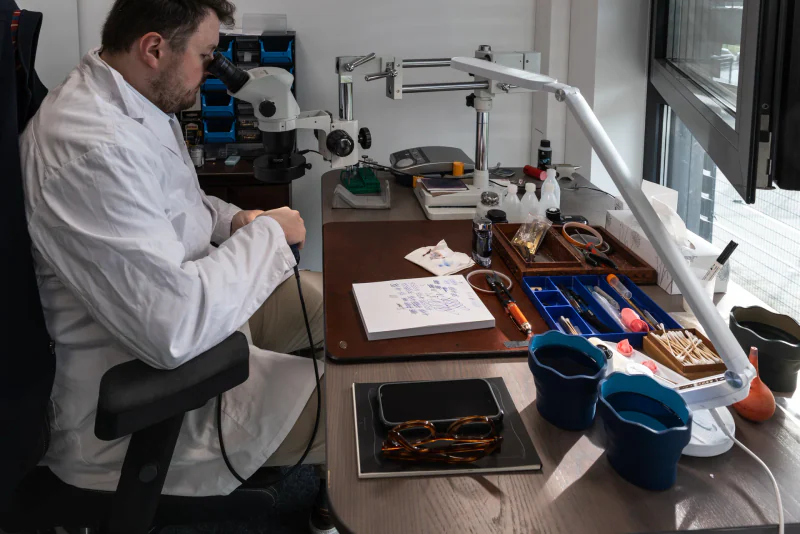
Phillip Landsiedel: When a Good Fountain Pen Can Write Even Better
Three familiar pens, a workbench in Hamburg, and a different feel on paper. A visit to nibmeister Phillip Landsiedel on our On the Road journey.
Read article
0 comments
Comments are moderated before publishing, so the conversation stays useful and calm.
No comments yet. You can leave the first note below.