Pelikan in Hanover: Stories from the Ink Castle
Inside Pelikan’s historic home in Hanover with Willi: stained-glass windows, archival inks, green stripes, a well-loved Toledo, and the people behind the pens.

Pelikan in Hanover: Stories from the Ink Castle
You can lock your phone and keep listening.
Follow My Pen — On the Road
Hanover, October 13, 2026
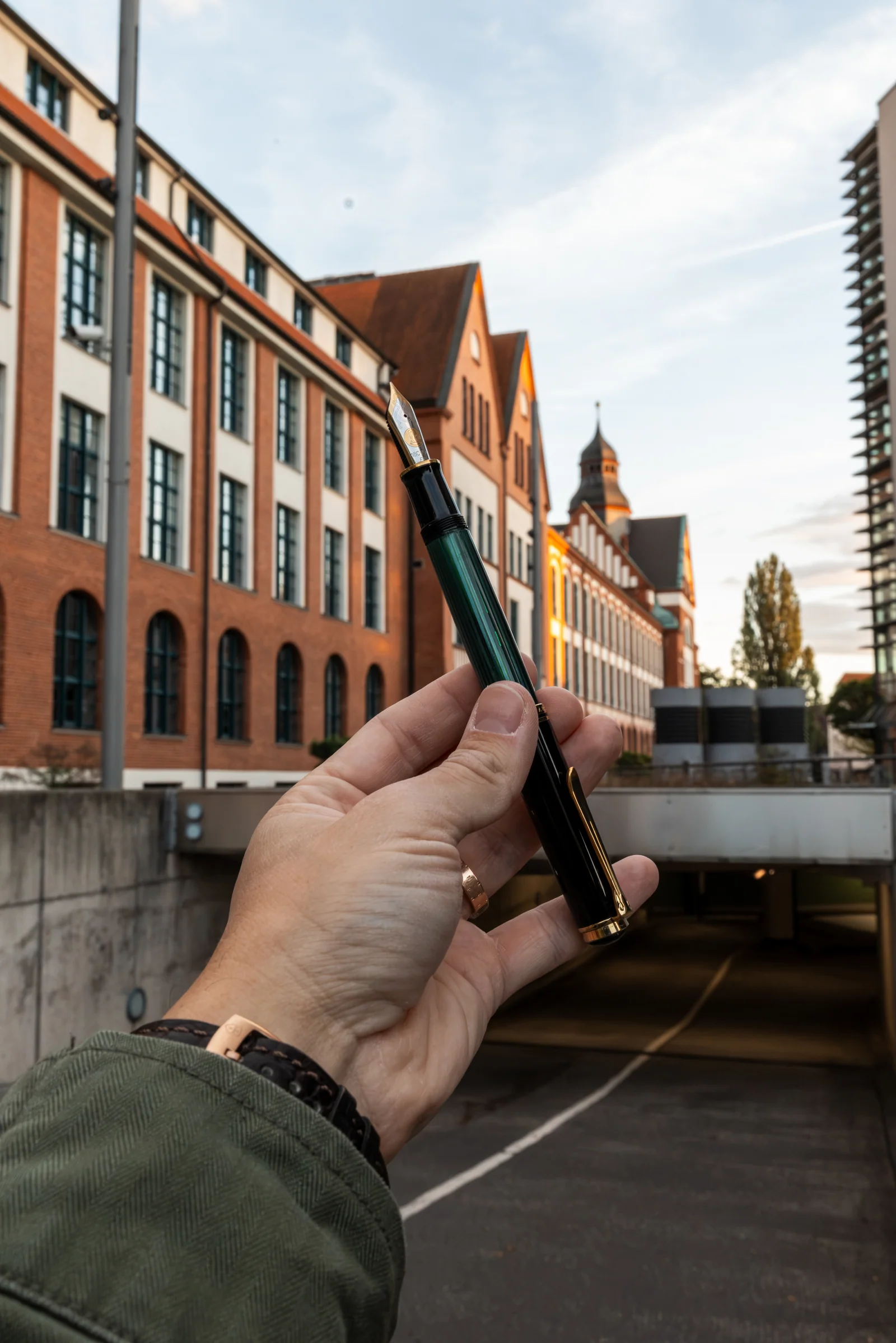
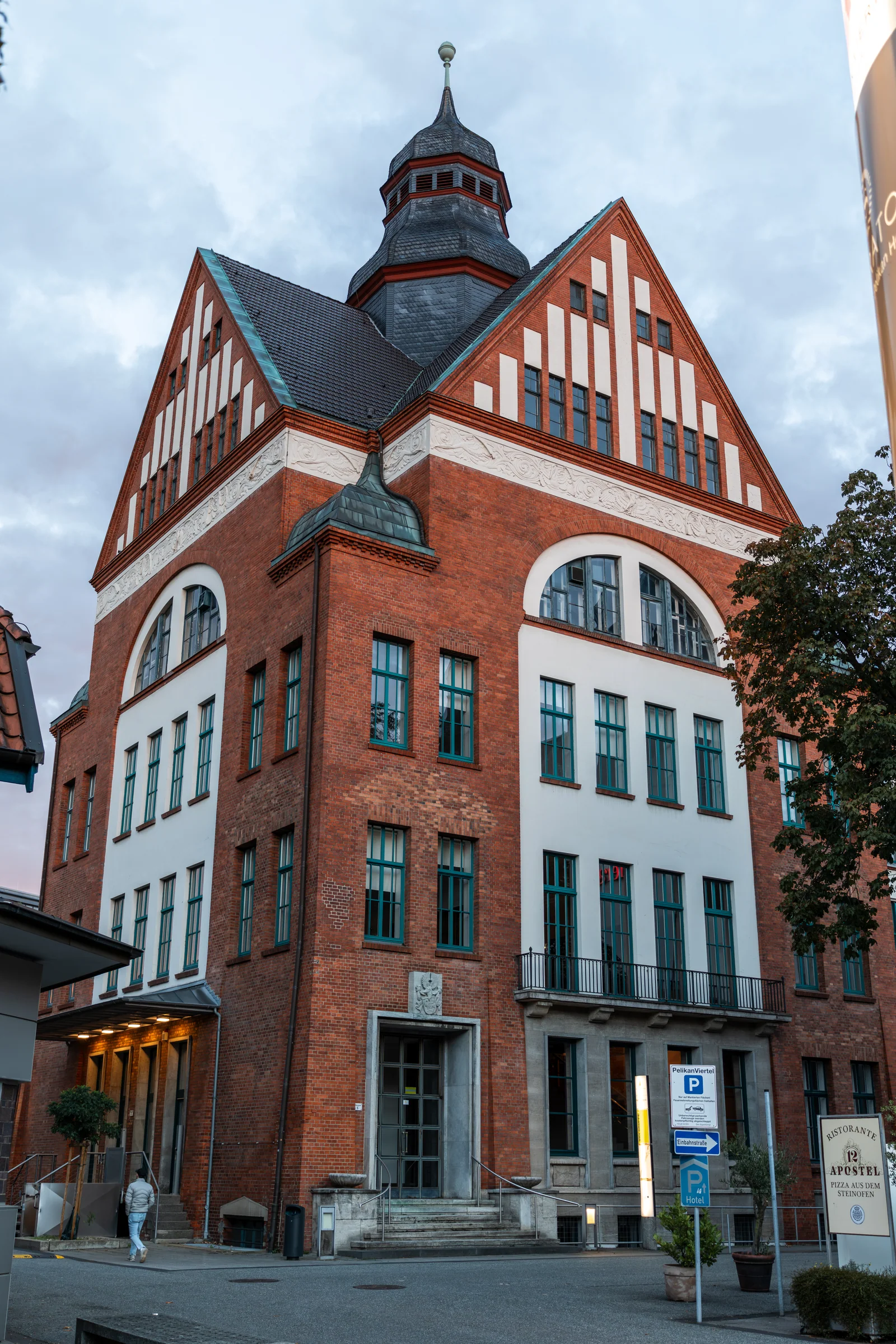
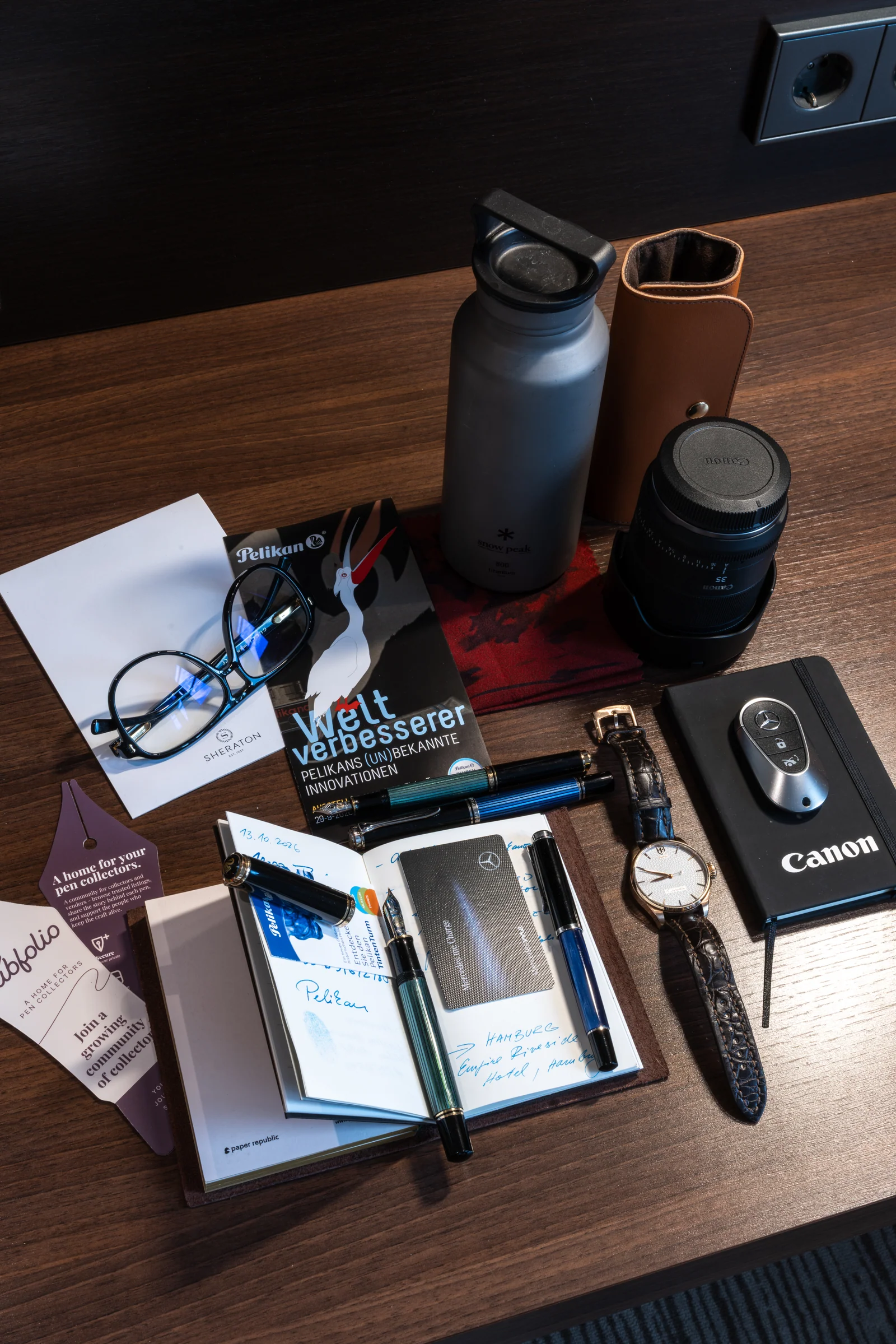
My wife and I spent the night in a former Pelikan factory in Hanover. We chose the Sheraton Hannover Pelikan Hotel precisely because of its connection to the brand, and staying on these grounds already felt like part of the visit. It was only during the tour, however, that I learned a detail that stayed with me: according to our guide, ink used to be cooked in the space now occupied by the hotel kitchen.
When you are interested in fountain pens, a detail like that can completely change the way you see the hotel where you have just spent the night. Suddenly, you imagine vats of ink, people at work, and bottles leaving Hanover for writing desks around the world.
Pelikan was the next stop on our On the Road journey. I arrived as someone who enjoys the brand’s pens and uses an M805 from my own collection. During the visit, however, a much broader story gradually unfolded. It was a story of colors, art, the everyday lives of employees, and just how much experience can be hidden inside an apparently simple object.
Willi and More Than Half a Century with Pelikan
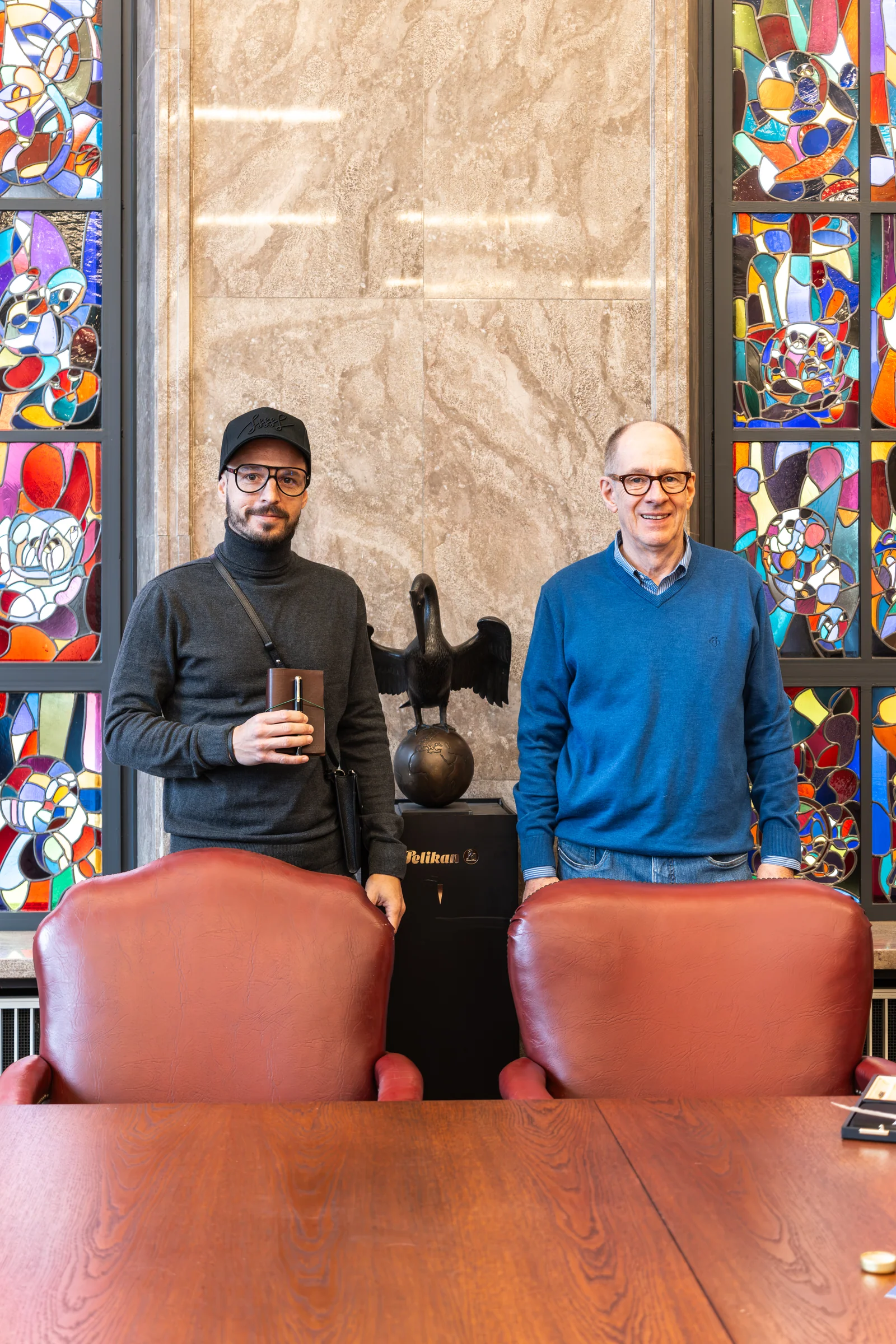

Our guide was Wilfried Leuthold, whom we knew as Willi. His working life with Pelikan began back in 1972. For decades, he worked in fine writing instruments, covering both marketing and product development, and he was there when the classic M400 returned in 1982. He is now retired, but he still returns to the company archive.
As he spoke, you could sense that he had experienced many of these events himself. He recalled former colleagues, production problems, and his own pen, which he had once saved up to buy. Occasionally, he would wander into a story you would never find in an official timeline, before returning to a photograph or an object on display.
Even the introduction felt personal. When he learned that my wife was accompanying me and supporting my work, he immediately brought her into the conversation. Thanks to him, the whole visit felt like a personal meeting. Willi was such a warm, friendly man. I could easily have spent hours talking with him.
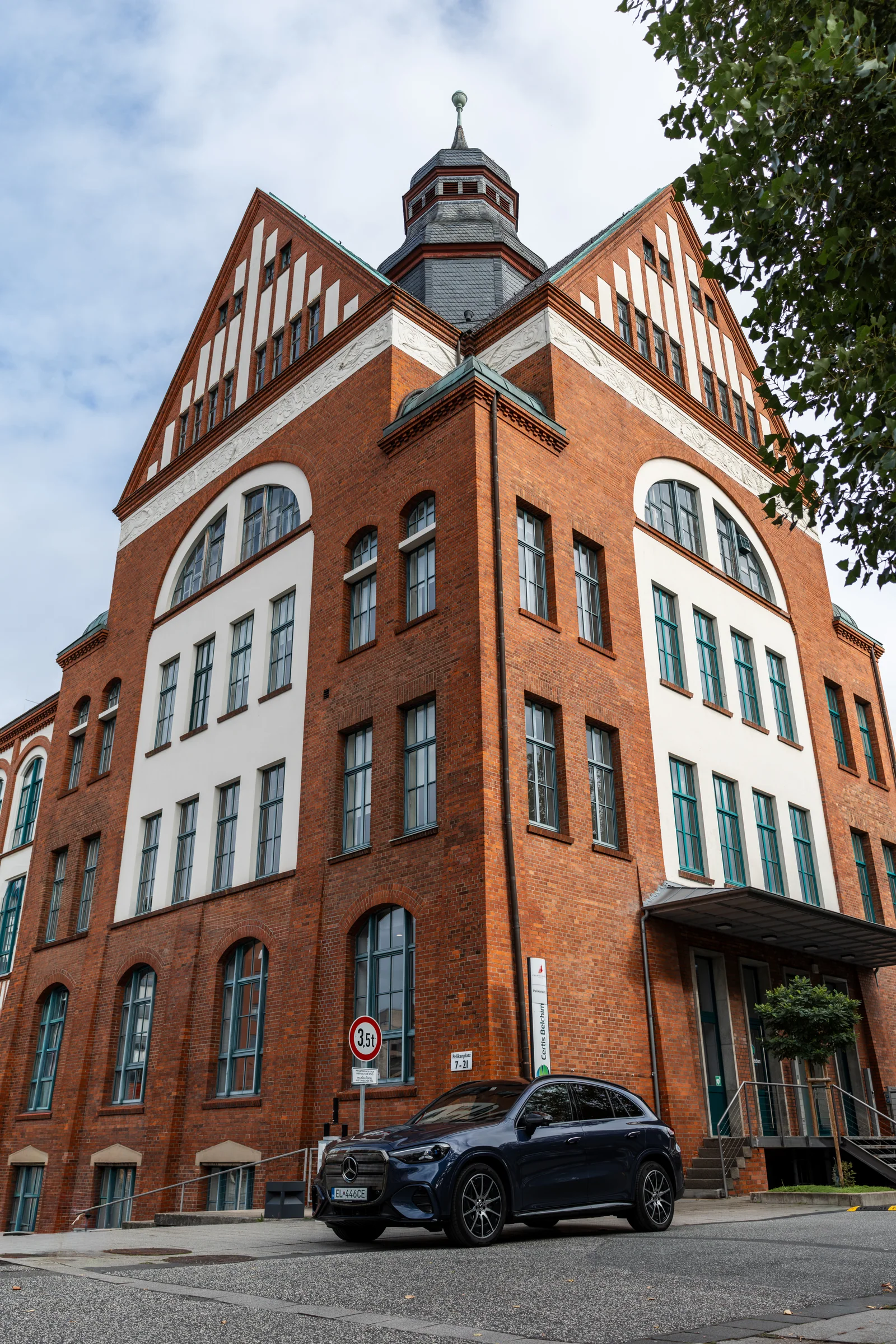
We were in the TintenTurm, on Pelikan’s historic grounds. Today, it houses exhibition spaces and a factory shop. The production of writing instruments had already moved to Peine-Vöhrum in 1973. In Hanover, we were therefore exploring the brand’s past through its archive, historic rooms, and the objects left behind by each era.
Color and Music in the Historic Hall
We began the tour in a large historic hall. Willi explained that its size had to do with the sales representatives who traveled to meet customers and regularly returned to the company. Here, they presented their results, learned about new products, and received information for their next trips. At a time when communication relied on personal meetings and correspondence, a room like this served a very practical purpose.
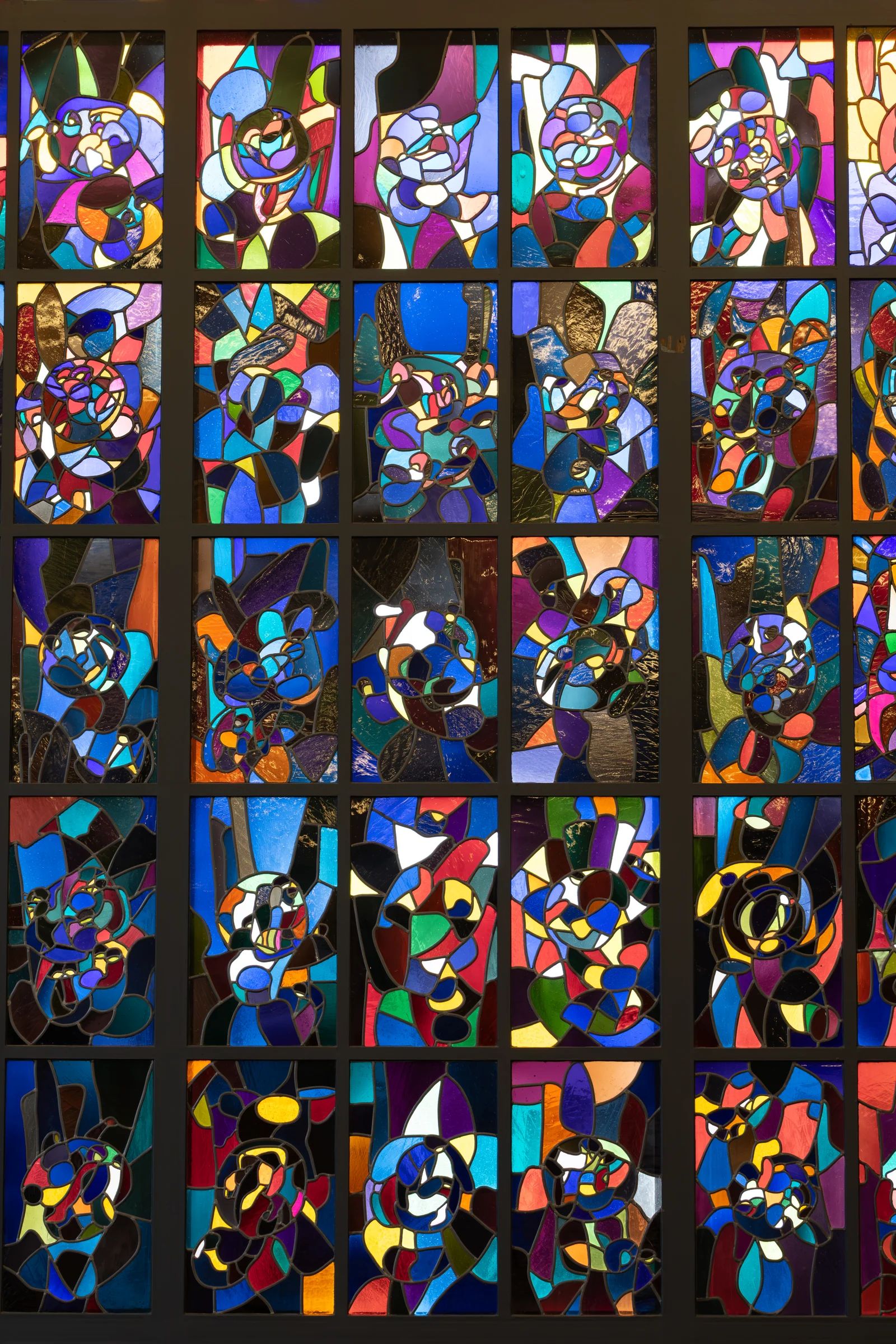
I was immediately drawn to the colorful stained-glass windows. They were designed by Adolf Hölzel in the early 1930s. They feel entirely at home in a company whose history began with making colors. Willi described how the morning sun passing through the glass casts patches of color across the floor.
While adding to the story, I came across an even more interesting detail: Hölzel based the composition of the windows on musical chords. He looked for relationships between colors similar to those between notes. He worked with tension and harmony, translating his system into abstract arrangements of color. The windows therefore have a connection to music, even though we experience them through our eyes.
Their history has another layer, too. They were almost completely destroyed during the Second World War. In 1963, they were reconstructed in a modified form using Hölzel’s surviving designs. What we see in the hall today is also the result of an effort to preserve something that could have disappeared forever.
A Birthday Marked by a Price List
Pelikan’s beginnings go back to the chemist Carl Hornemann, who started producing colors and ink in 1832. The company’s official birthday, however, is considered to be April 28, 1838, the date of its first price list.
Willi showed us what it looked like and added a detail that made me smile: there was apparently a note on the back warning people not to throw it away, because it might be important. Looking at the brand’s almost two centuries of history, someone clearly judged its significance rather well.
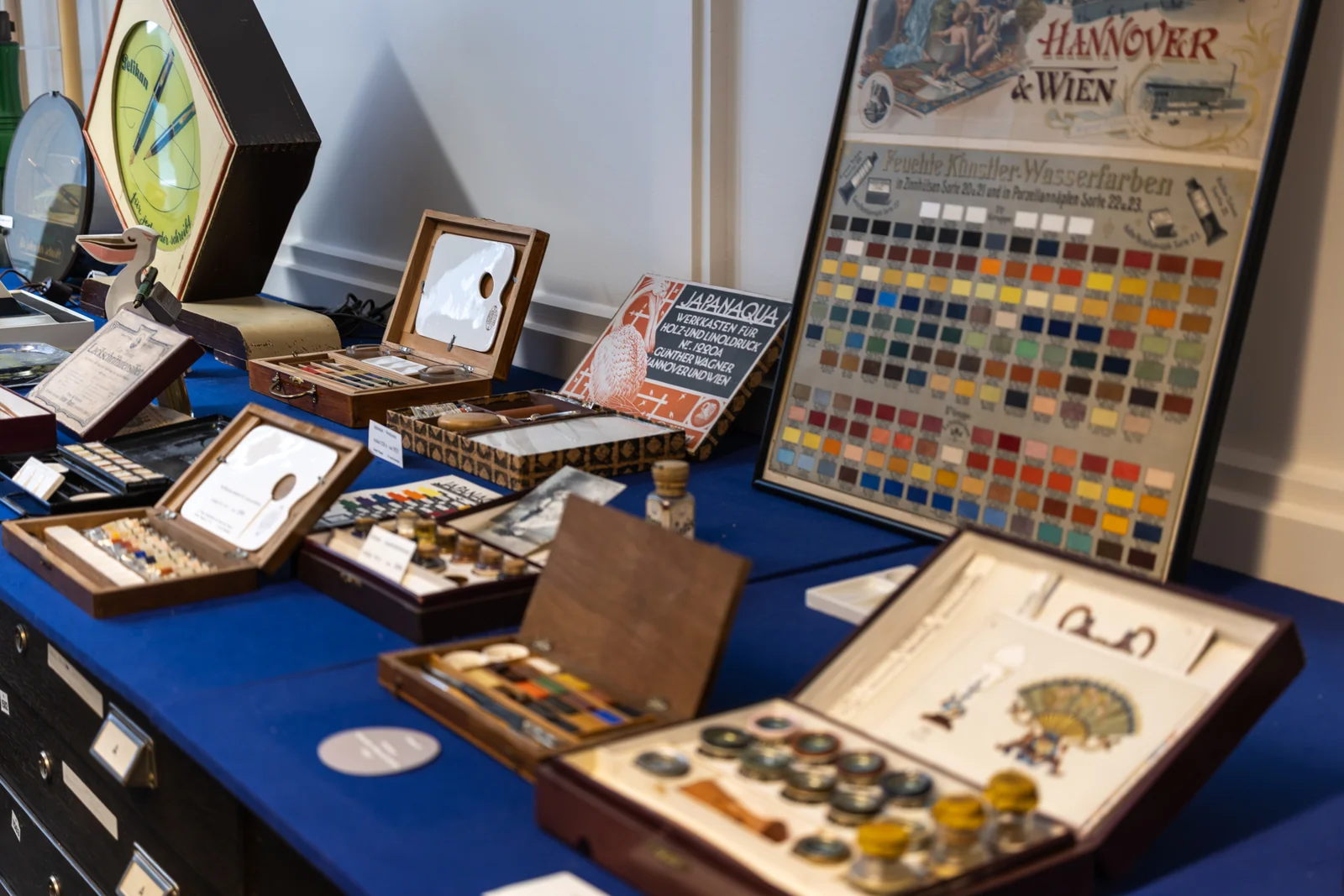
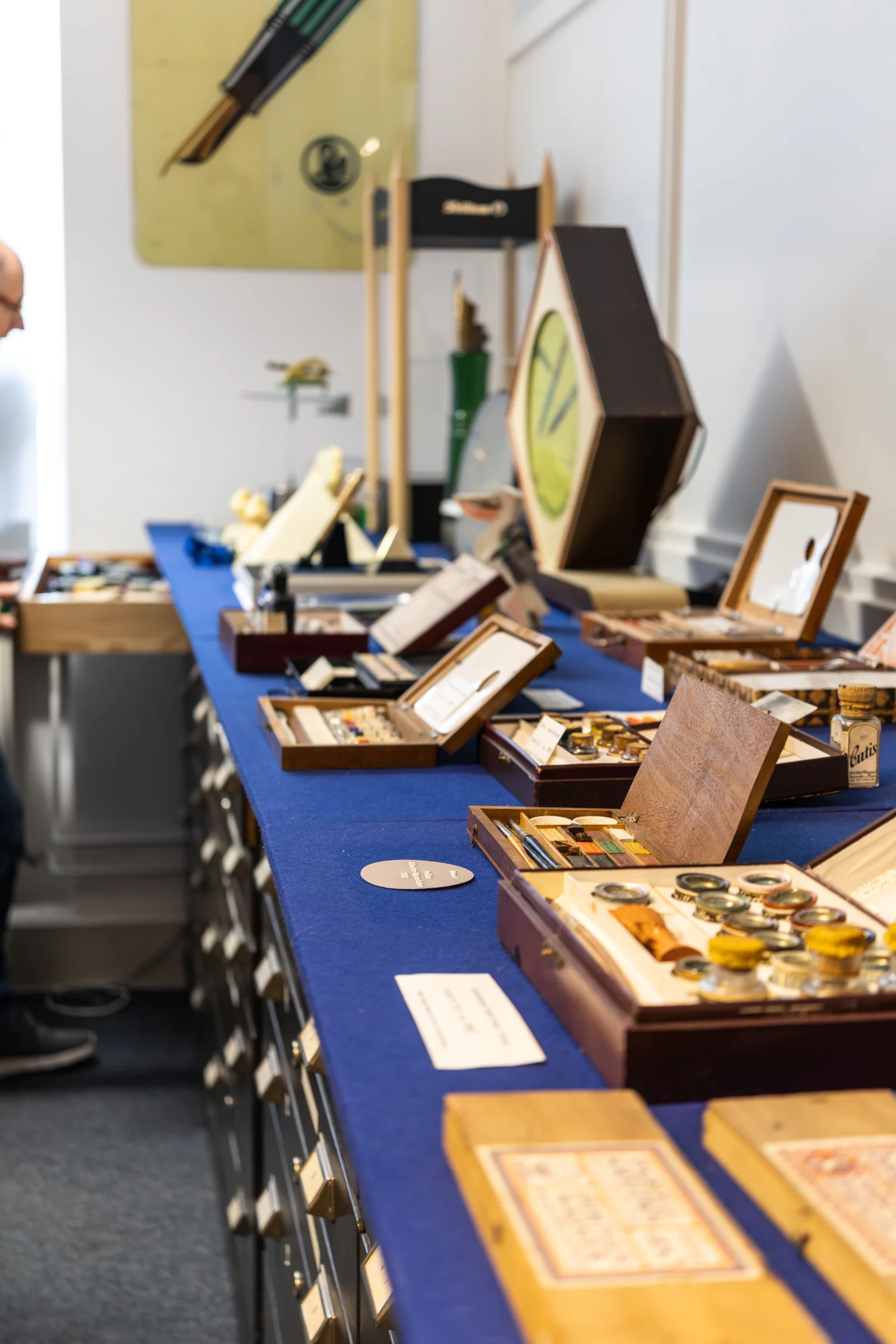
Customers at the time needed colors and ink for far more things than we might immediately imagine today. Technical drawings, illustrations, and business materials were all drawn by hand. So were advertising signs. Later came large theater and cinema posters, which had to be painted again whenever the program changed.
Looking at the archive photographs, I began to appreciate how much work went into things that we now create on a screen and send to a printer. For a manufacturer of colors, this represented an entire world of customers and needs.
Pelikan’s first fountain pen did not arrive until 1929. By then, 91 years had passed since the company’s official founding. Ink therefore has a history with Pelikan that is almost a century longer than that of its fountain pens.
Pelikan, through the years
1832 · Before the first pen
Carl Hornemann begins making colors and ink in Hanover. Pelikan’s story starts with what goes onto the paper, decades before its first fountain pen.
The beginnings1838 · A date on a price list
The first price list is dated April 28, 1838. This is the date Pelikan celebrates as its founding day, even though production had begun earlier.
The price-list story1878 · A family in the nest
On November 27, the pelican with four chicks becomes a registered trademark. The emblem comes from Günther Wagner’s family coat of arms.
The story behind the logo1906 · The ink castle takes shape
A new factory opens on Podbielskistraße. Its towers and brick façades are part of the historic grounds we explored with Willi.
Inside the ink castle1929 · Ink moves inside the pen
Pelikan introduces its first fountain pen with a differential piston-filling mechanism. Its ink-making history is already almost a century old.
The piston-filling story1950 · The green stripes arrive
The Model 400 introduces the green-striped look that becomes a Pelikan signature. The pattern is built into the barrel material itself.
How the stripes are made1960 · Meet the Pelikano
Developed with handwriting educators, teachers, and students, the Pelikano brings the brand into schoolbags and classrooms.
The everyday innovations1973 · From Hanover to Vöhrum
Writing-instrument production moves to Peine-Vöhrum. Our Hanover visit follows the brand’s history through its old buildings and archive.
The place we visited1982 · A new chapter for the M400
The Souverän M400 revives the classic 400. Willi remembers calling on retired colleagues to help recover the skills needed to work the striped material.
Willi’s story of the return1996 · Filling from the other end
The Level uses a special bottle to fill through the rear of the pen. Customers do not embrace the unfamiliar system, and production eventually ends.
The experiments and surprises2007 · The Majesty looks back
The Majesty’s decorative ring echoes the pelican frieze on the historic factory towers. A detail high above the street finds its way into the hand.
The pelicans overhead2026 · Our turn to visit
On October 13, my wife and I visit Hanover with Willi as our guide. The pens become connected to people, places, and drawers I could explore for days.
What stayed with meTimeline sources
Historical dates: Pelikan’s company history and its histories of 1950–1982 and 1982 onwards. Willi’s recollections and our 2026 visit come from this article.
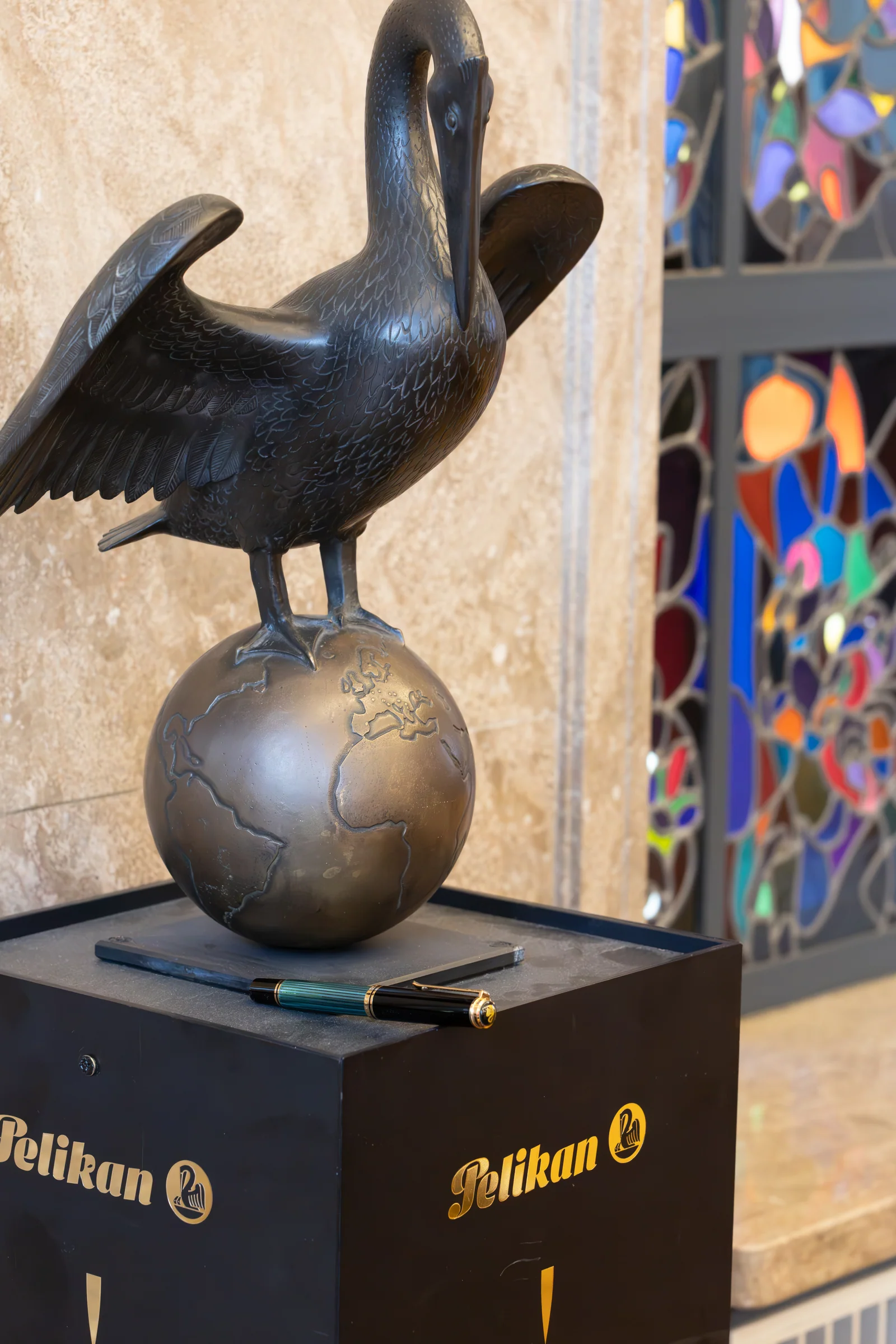
Why There Is a Pelican in the Logo

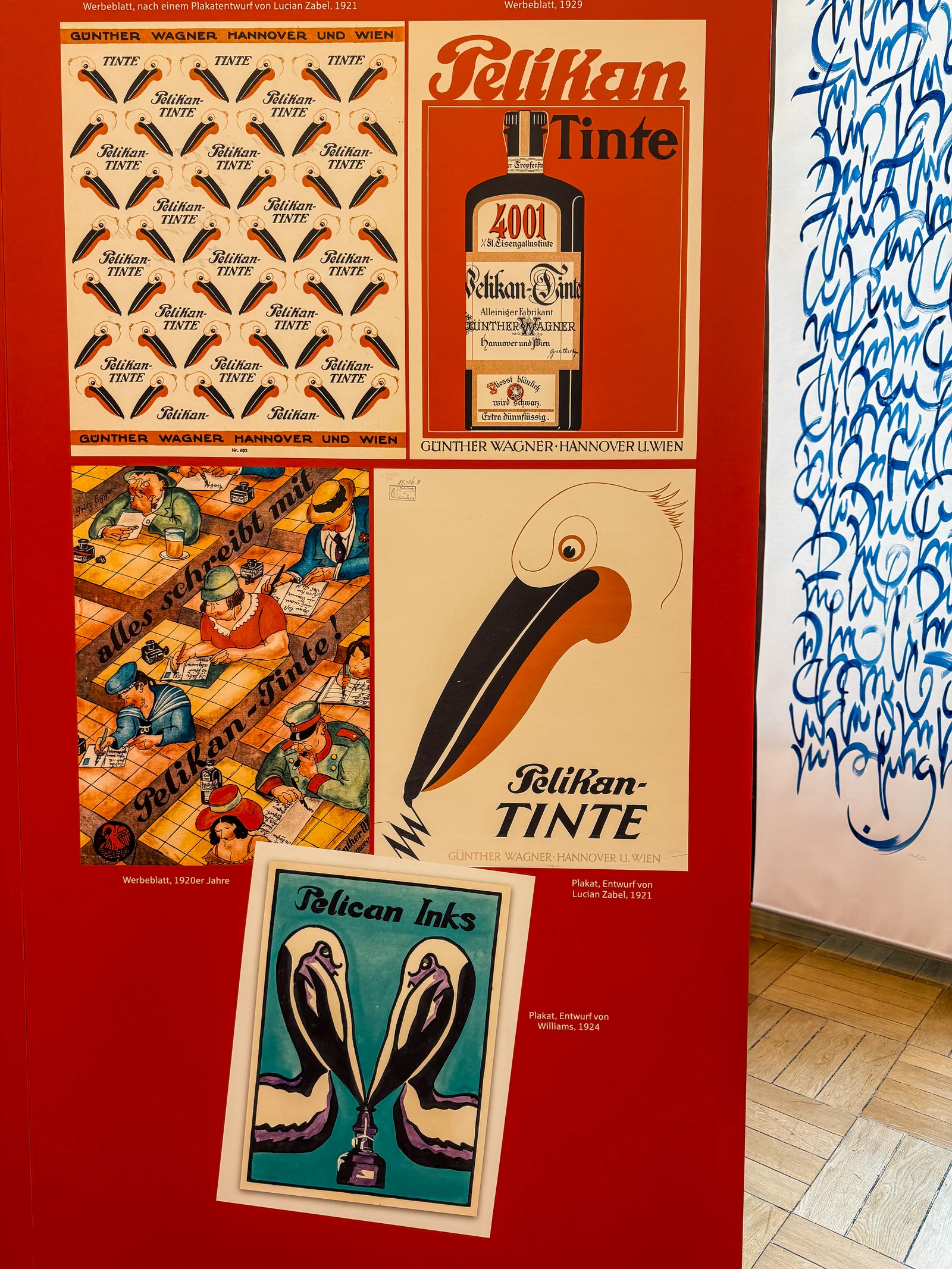
Günther Wagner took over the business after Hornemann. He was the person who gave the brand the symbol we recognize today. He found the pelican in his own family coat of arms and used it to identify the products.
The loveliest detail is in the nest. Originally, there were three chicks. When a fourth child joined Wagner’s family, another chick was added to the emblem. The trademark registered on November 27, 1878, therefore carried a small family story of its own.
The pelican also appeared on children’s watercolors, which used honey as a binder. The combination of paint and honey may sound unusual to a modern reader, but it had its place in the art materials of the time.
The next time you pick up a classic Pelikan, take a look at its clip as well. Its distinctive shape resembles a pelican’s beak. The brand’s visual identity continues beyond the little logo on top of the cap.
It once went further still: real pelicans lived at the factory entrance. Their presence is also documented in the history of the site. Willi explained that they were intended to bring a little pleasure to employees arriving for work in the morning. The idea of being greeted by a living company symbol on your way into the factory stayed with me.
A signature through time
Explore the bird and the lettering. Each has its own timeline.
The symbol

The family coat of arms
The Wagner family’s heraldic starting point.
The lettering

An ornamental beginning
Dimensional lettering for drawing ink.
Historical reference
Original marks and dates from Pelikan — The Brand, by Detmar Schäfer, p. 2 of the extract. The c. 1873 reproduction is from Pelikan’s brand archive. Dates identify the illustrated examples; designs could overlap in use. The animated blue pelican is from Pelikan’s website.
The Ink Castle and the Pelicans Overhead
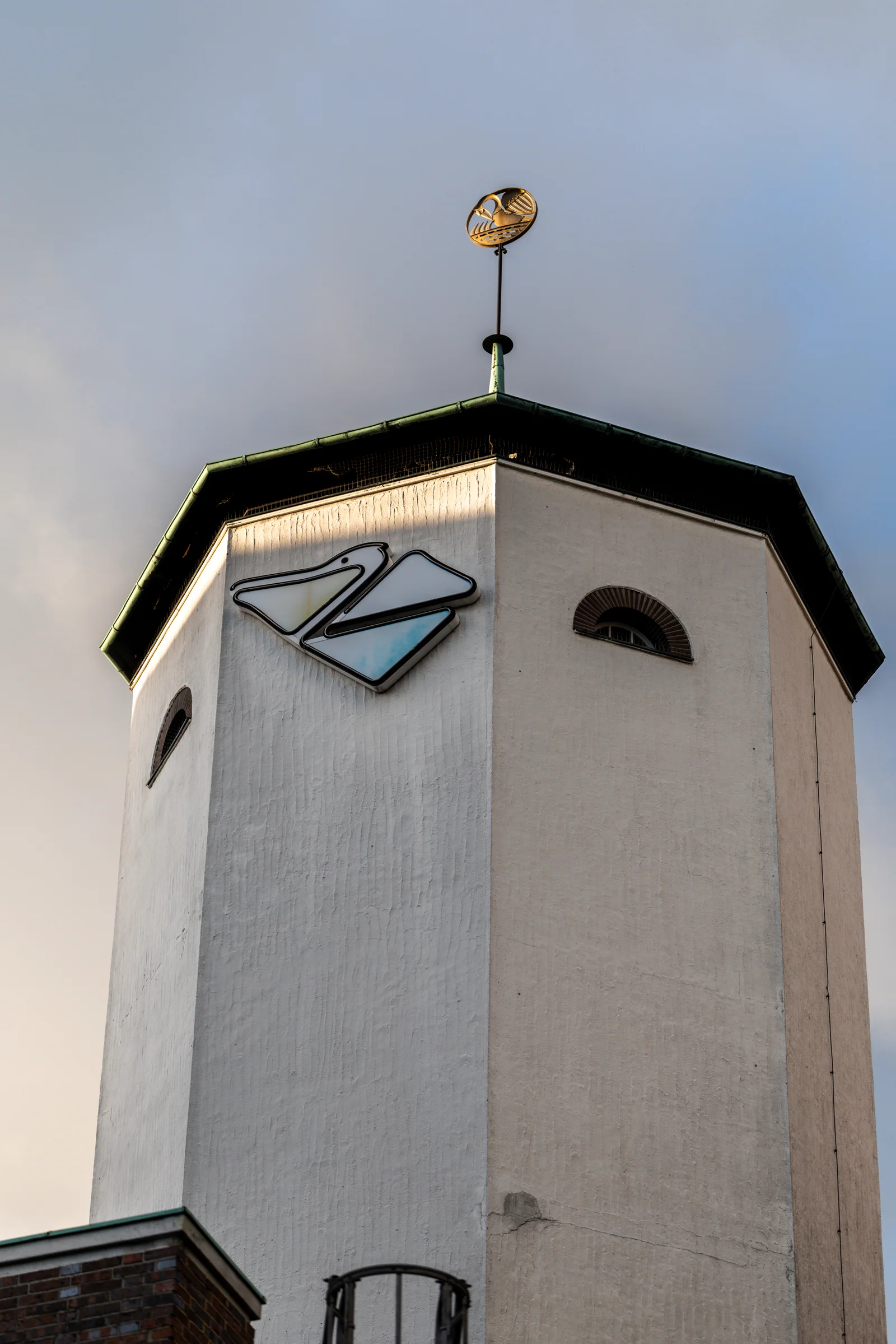
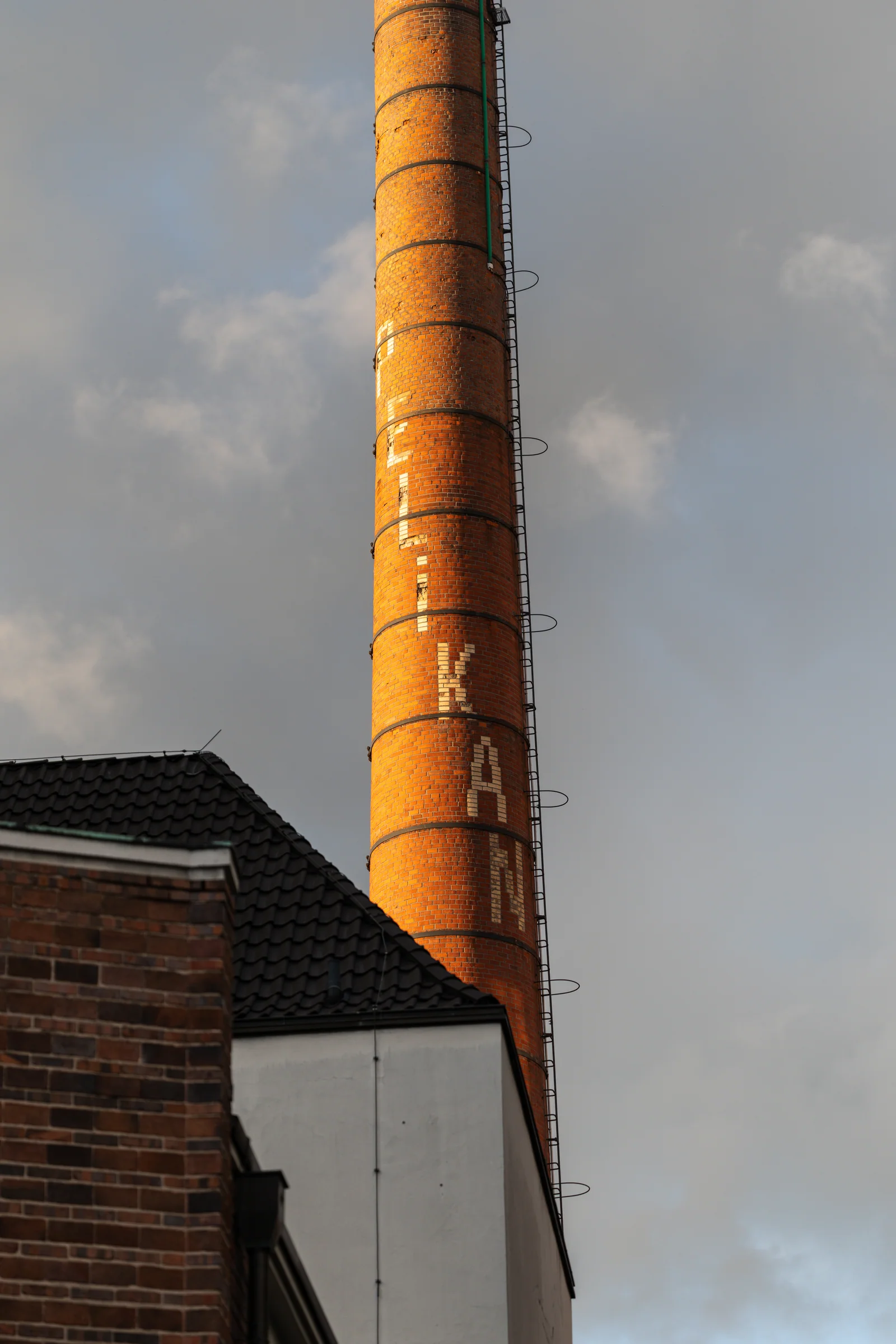
As the company grew, it needed more and more space. It opened a new site in 1906 and expanded it significantly in 1913. Looking at the towers, brick façades, and decorative details, you understand the name Willi mentioned to us: the ink castle.
He also connected the construction of the factory with two names I had not expected to hear during this visit. According to his account, August Oetker and Siegmund Seligmann of Continental helped Fritz Beindorff finance it. For a moment, the history of ink took us into baking powder and tires. Industrial stories, too, connect through individual people.
Willi pointed out the pale decorative band high on the façade. From a distance, it can look like a simple ornament. Look more closely, however, and pelicans in various poses begin to appear. He admitted that he had walked past them for years without realizing what he was looking at.
This detail has an interesting continuation in the world of pens. The decorative band on the Pelikan Majesty, introduced in 2007, refers to the historic frieze on the factory towers. A piece of the façade found its way onto an object you can hold in your hand.
Today, the site has a new life. It is home to a hotel, restaurants, offices, and apartments. After hearing about its past, it is worth looking up at the details high overhead as you walk around.


Half an Hour for a Bath During Working Hours
A large part of Willi’s account concerned Fritz Beindorff, who took over the company in 1895. I was particularly interested in what life and work at the factory had once been like.
Willi described company bathrooms and showers that employees could use for half an hour during working hours once a week. At a time when a private bathroom was far from standard in many homes, this was a very tangible improvement to everyday life. For people working with colors and chemicals, it also had a straightforward practical purpose.
He also mentioned two hundred bicycles that the company bought for employees and allowed them to pay for in installments. For someone who could not afford regular tram fares and faced a long walk to work, a bicycle could save a substantial part of the day.
There was also a doctor, social support, and a canteen offering affordable hot meals. Work anniversaries were marked with flowers at the employee’s workstation and music from the company band. Long-serving employees received jewelry bearing the pelican symbol; for significant anniversaries, small diamonds appeared in the nest.
The most ambitious arrangement was one Willi described as a promise of a full salary for life after forty years with the company. According to his account, it eventually became financially unsustainable and was discontinued. It was interesting to hear the business reasoning behind it as well: the company wanted to retain experienced people and the knowledge that competitors were keen to acquire. Employee welfare and the interests of the business came together very directly here.
The history of this same place also includes the Nazi era. The City of Hanover states that more than two thousand forced laborers had to work at the company’s two sites during the war, and that punitive labor camps under Gestapo supervision also existed there. It also points to the responsibility of the management, including Beindorff. Since June 2026, an information panel on Pelikanplatz has addressed this part of the past. This context, too, belongs in any account of the company and its former owner.
1929 and the Ink Inside the Pen
When we turned to fountain pens, we came to the name Theodor Kovács. The Hungarian engineer developed a differential piston-filling mechanism and sold the patent rights to Günther Wagner in 1927. Two years later, the first Pelikan fountain pen reached the market.
For someone who has never used a piston-filling pen, its operation is easy to explain. Turning the end of the pen moves a piston inside the barrel. With the nib immersed in ink, moving the piston back draws ink into the pen’s own reservoir. A bottle can therefore be used to refill the pen repeatedly.
Pelikan combined this mechanism with a carefully designed system for feeding ink to the nib. At a time when users were concerned about capacity, clean filling, and unwanted blots, these were important practical qualities. The first pen also allowed users to check the remaining ink through a transparent section of the reservoir.
It is worth distinguishing the brand’s first pen from the invention of the fountain pen itself. Pelikan entered an already established world of writing instruments with a significant technical solution of its own.
Willi also reminded us of a surprising connection with Montblanc: Pelikan sourced the nibs for its first fountain pens from that company. For a collector who now sees each brand through its own distinct identity, it is a lovely reminder of how closely manufacturers could be connected in the past.

The Green Stripes Have a Surprising Beginning in Cotton

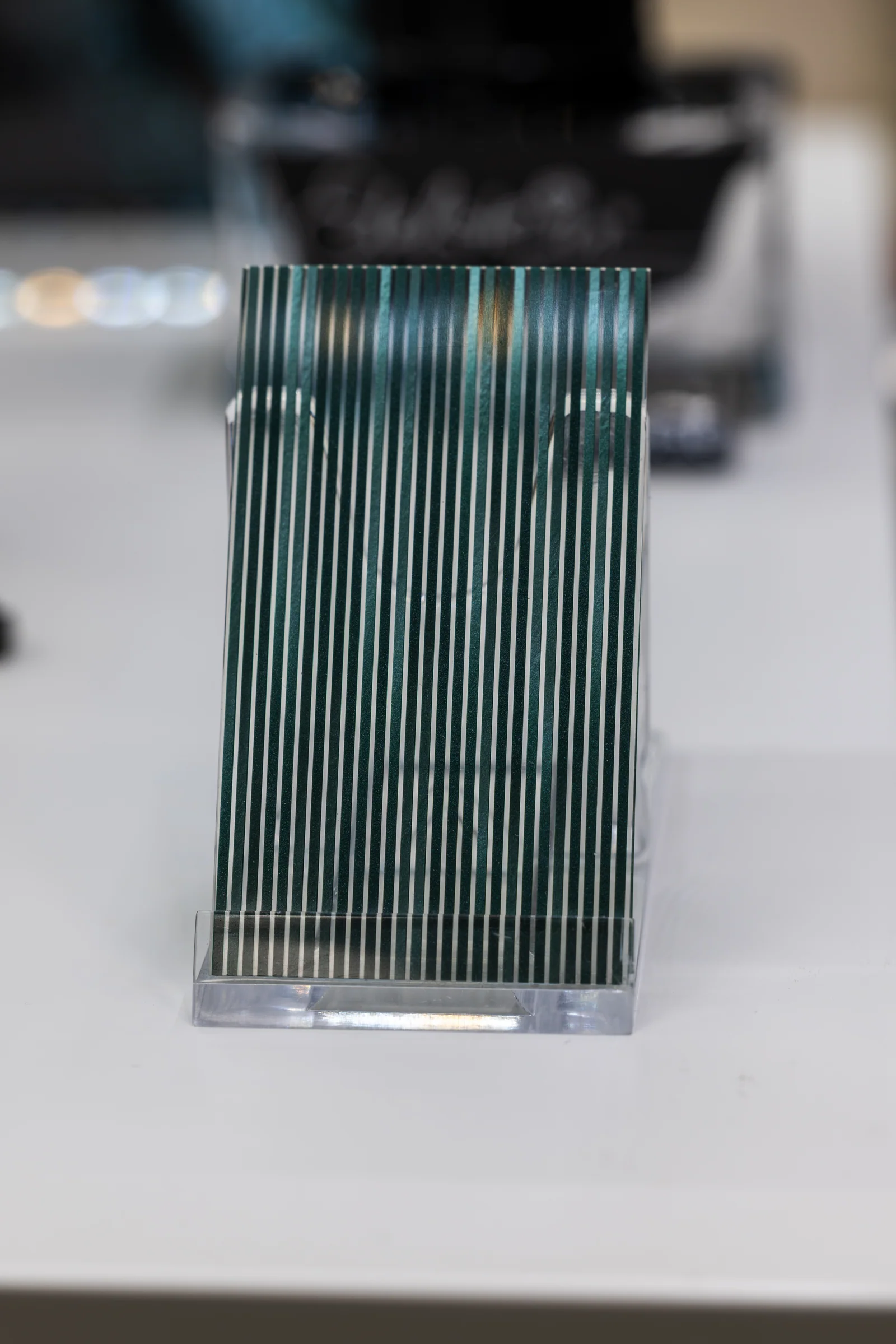
For me, the green and black stripes are among Pelikan’s most distinctive features. The Model 400 appeared with this look in 1950, establishing a recognizable design that the brand continued to develop.
I also love the consistency of Pelikan’s classic pen designs. Across different sizes, colors, and materials, that familiar shape remains instantly recognizable to me. I look at one and know it is a Pelikan. There is something satisfying about seeing how much variety can grow from a shape the brand has made its own.
Willi explained how much work lies behind that surface. Cotton is the starting material for the striped cellulose acetate. It is processed into a material from which colored layers and blocks are formed. Further stages then produce the characteristic striped pattern. Making this material can take months.
The stripes are formed within the material itself. The prepared sheet is shaped into a tube, a sealing layer of resin is added inside, and the outer surface is precisely machined and polished. Even the join has to fit into the pattern so that the finished barrel looks continuous.
When you see a pen like this in a display case, you notice a regular pattern and a polished surface. After hearing how it is made, you start looking at the precision of the stripes, the continuity of the material, and everything that could interrupt the finished result.
The stripes also have a connection to the nickname Stresemann. It refers to the striped clothing associated with the German politician Gustav Stresemann. It is a small example of how the history of fashion can find its way into the world of writing instruments.
When Former Colleagues Had to Be Called Back
One of the most memorable stories of the visit concerned the return of the classic model in 1982. That was when Pelikan introduced the Souverän M400, building on the postwar 400. Willi was there.
He told us that, when production was being revived, the team ran into problems working with the striped material. They needed to master processes that an earlier generation had used years before. Help eventually came from retired employees who had once made these pens themselves.
What struck me about this story was how quickly experience can disappear when it is no longer used. A drawing records dimensions, and instructions set out the individual steps. But someone who has done the work for years also knows when the material needs a different approach, where a fault is developing, or what still works even if it looks odd on paper.
With a pen that looks so simple, we rarely think about these things. Hearing them from someone who had been personally involved in that return made the story all the more compelling.
A Toledo Bought with His Own Savings
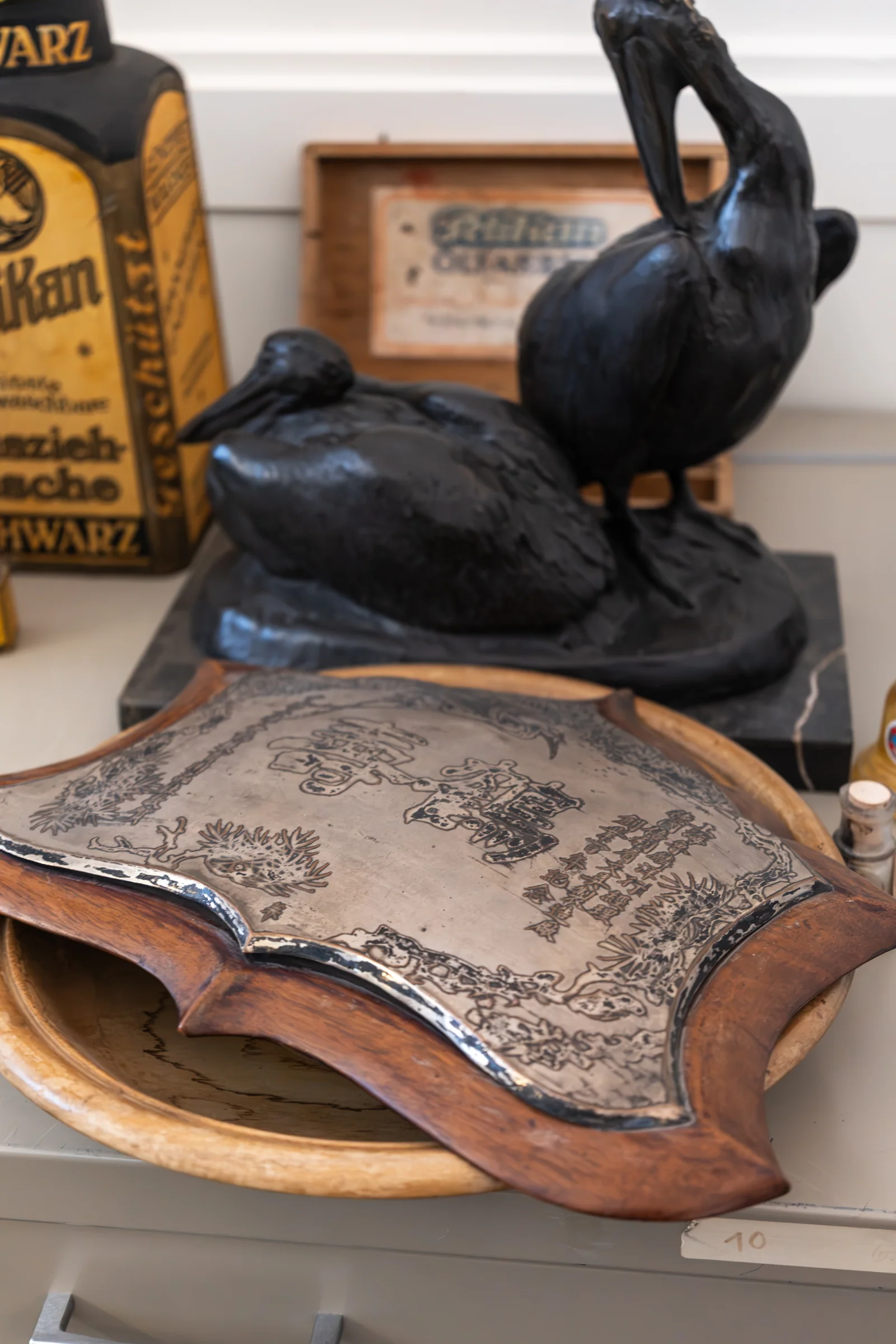
I asked Willi which pen was his favorite. His answer was the Toledo.


He bought one after the model returned in the 1980s. Even with the more favorable employee price, he had to put money aside for it. He had brought it along to show us, and for a moment the conversation about history became a conversation between people with a personal attachment to a particular pen.
The Toledo has a distinctive decoration featuring pelicans. Its name refers to the Spanish city and the tradition of damascening, in which iron or steel was decorated with gold. The modern Pelikan Toledo uses a decorative sleeve of 925 sterling silver, a layer of gold, and details finished by hand.
It was clear from Willi’s account that his favorite pen had a value tied to a particular period of his life. I understand that very well. With my own collection, I often remember why I wanted a particular pen and what was happening in my life when I acquired it.
From a German Workshop to a Japanese Studio
When we came to the artistic editions, I asked something that had interested me for a long time: how did Japanese maki-e become part of the German Pelikan story?
Willi explained the difference in how the brand was perceived. In Germany, Pelikan can mean school paints, an eraser, ink, or an expensive fountain pen. According to his account, the Japanese operation focused on fine fountain pens, which also created room for collaboration with local artists. Black pens made in Germany traveled to Japan, where they received their decoration by hand.
In maki-e, motifs are created with urushi lacquer and fine gold or silver powder. The result requires patient work in layers and a great deal of time. A pen can therefore carry both a scene rooted in Japanese cultural symbolism and the individual touch of a particular artist.
Raden uses mother-of-pearl taken from mollusk shells. Small pieces are arranged into patterns whose reflections change with the light and the viewing angle. Pelikan also uses these techniques on the M800 and M1000 platforms.
What attracts me to these pens is the combination of a familiar construction with an entirely different approach to the surface. Even the classic striped motif can take on a new character in mother-of-pearl. You really need to see such a pen in motion; a single photograph captures only part of what happens on its surface.
Ink in Wine Bottles and in Tablets
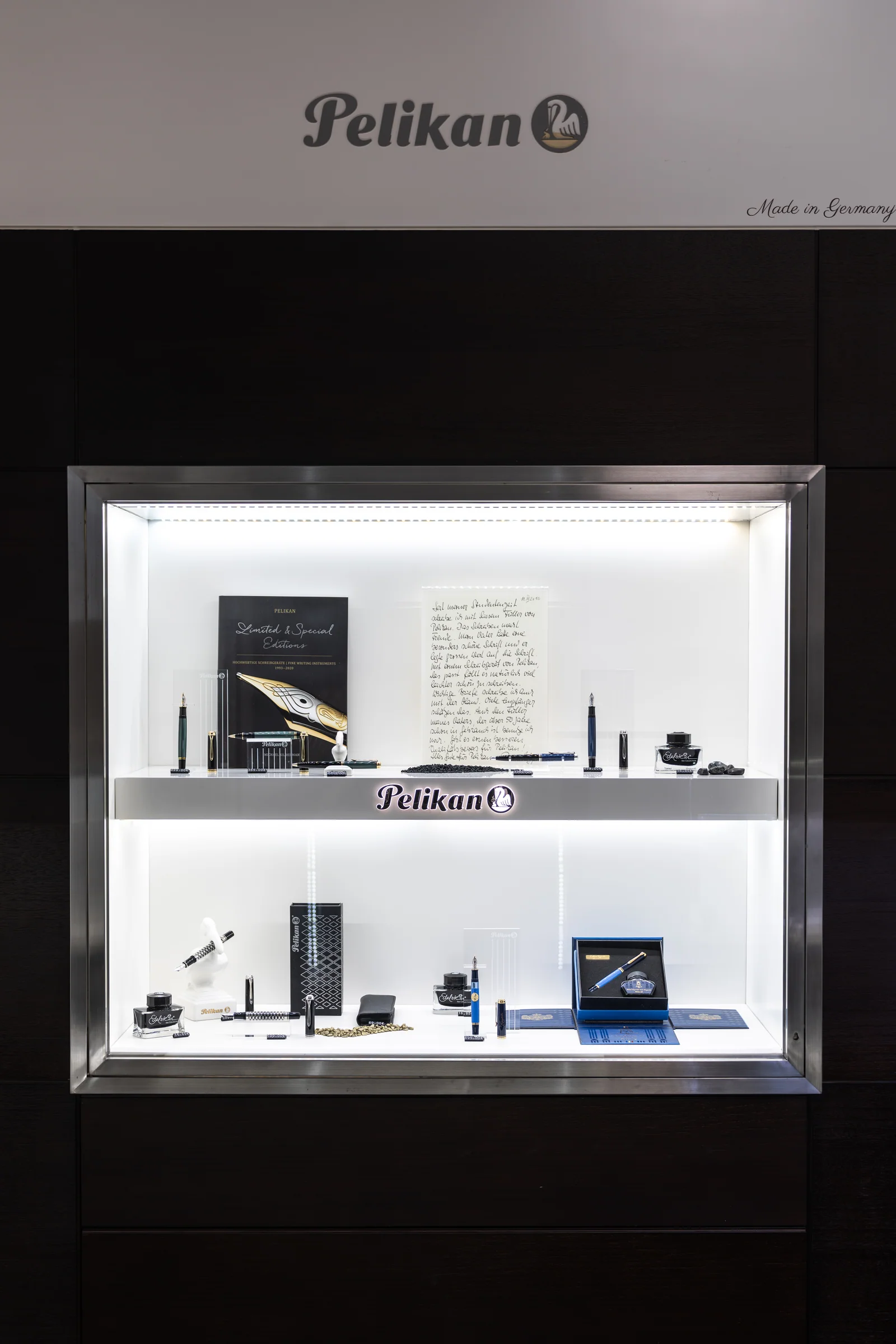
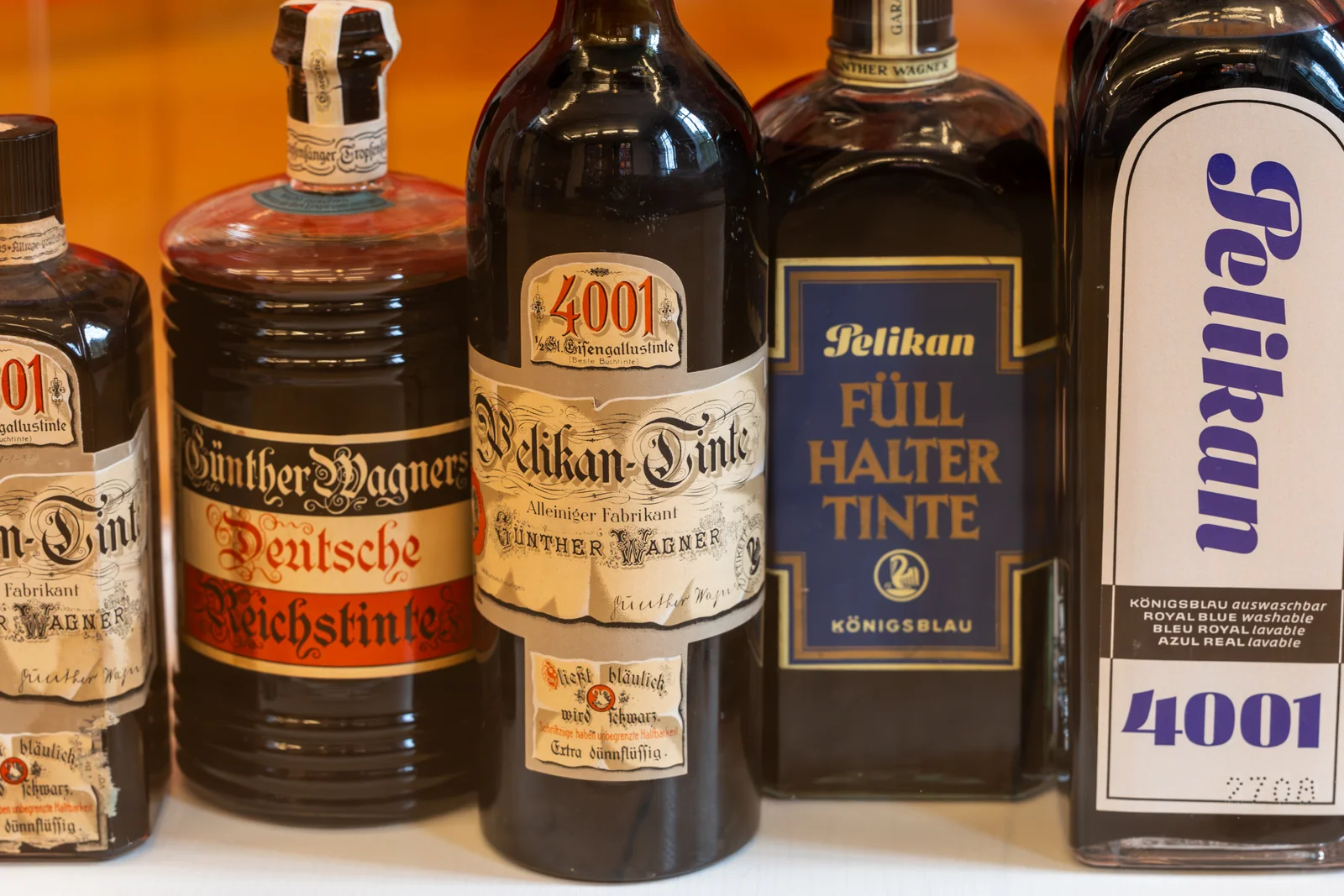
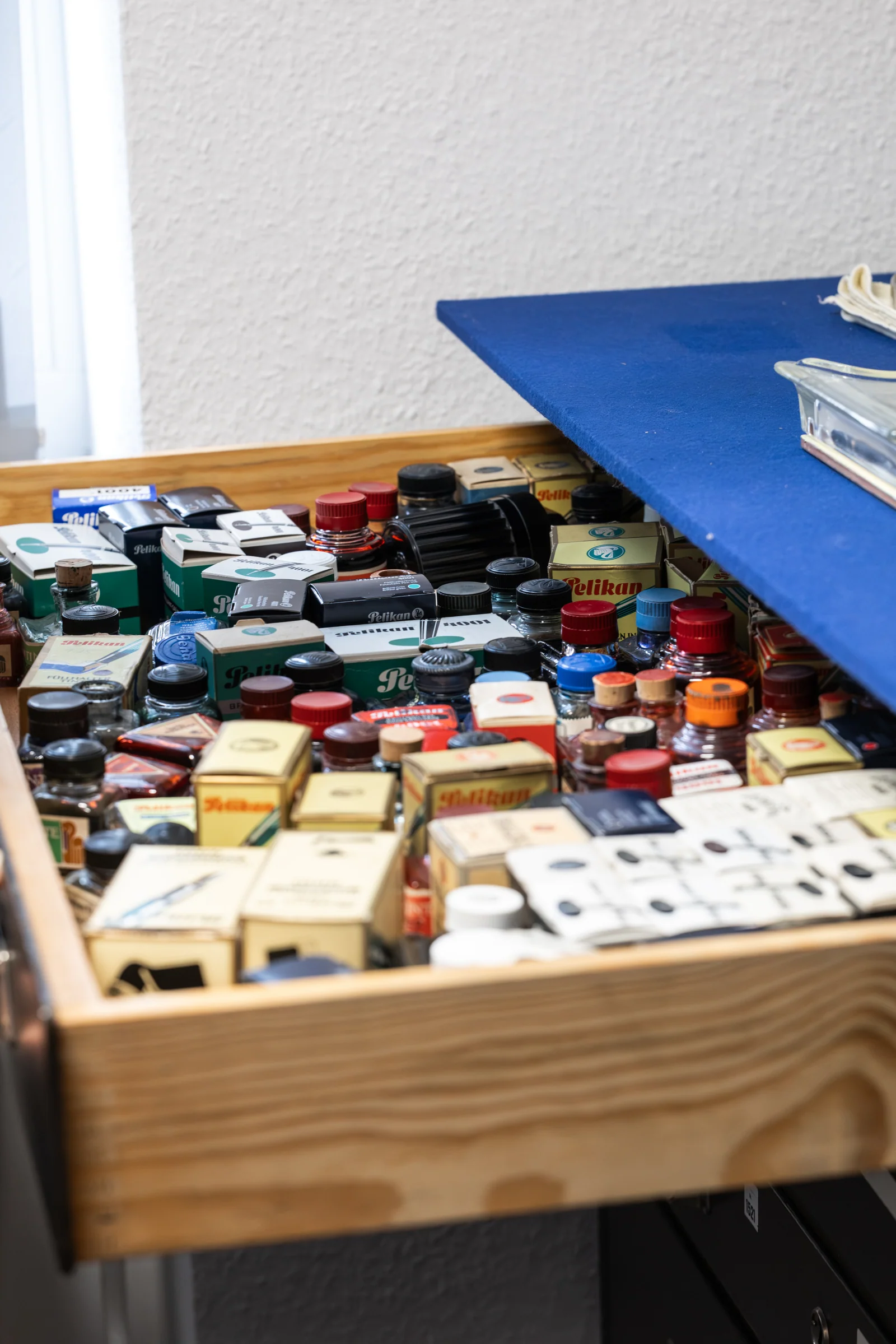
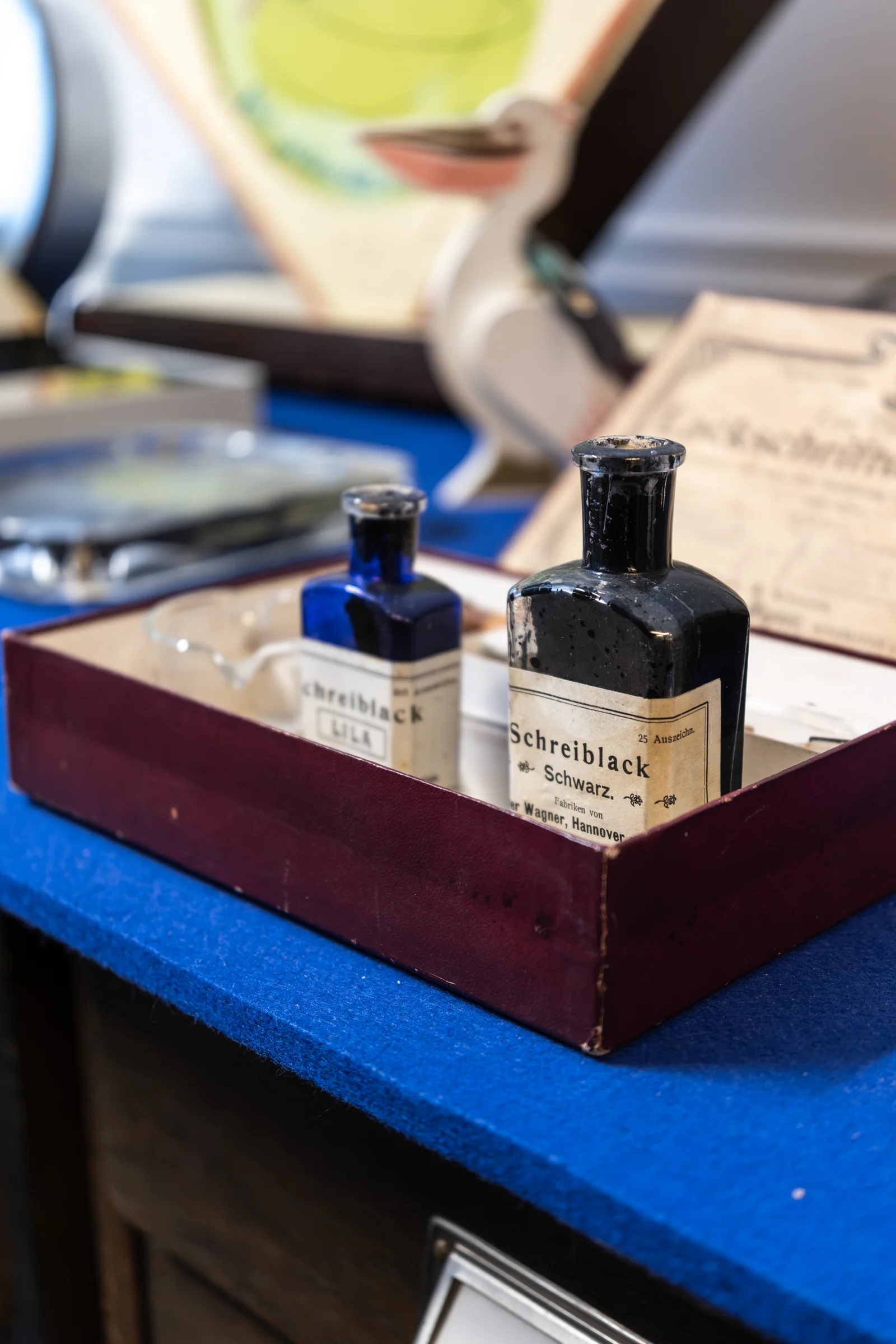
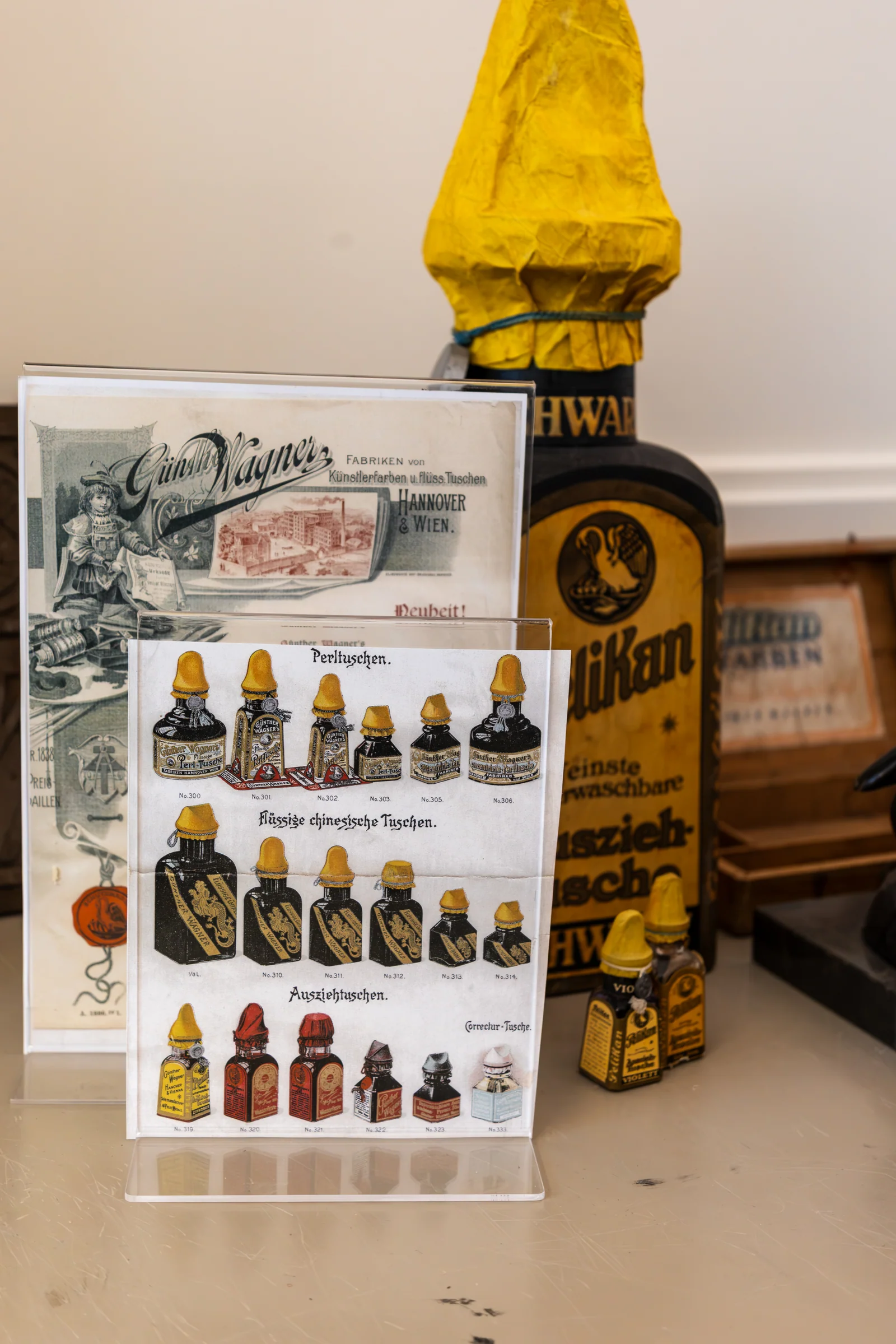
At the ink displays, we returned to the very beginning of the story. We saw old packaging, large supply bottles, and solutions that seem surprising today.
Willi mentioned that, in the early days, bottles originally intended for wine were also used because they were readily available. Larger containers supplied schools and offices, where the ink was poured into smaller vessels. Imagine a classroom with inkwells set into the desks, and a one-liter bottle starts to make a different kind of sense.
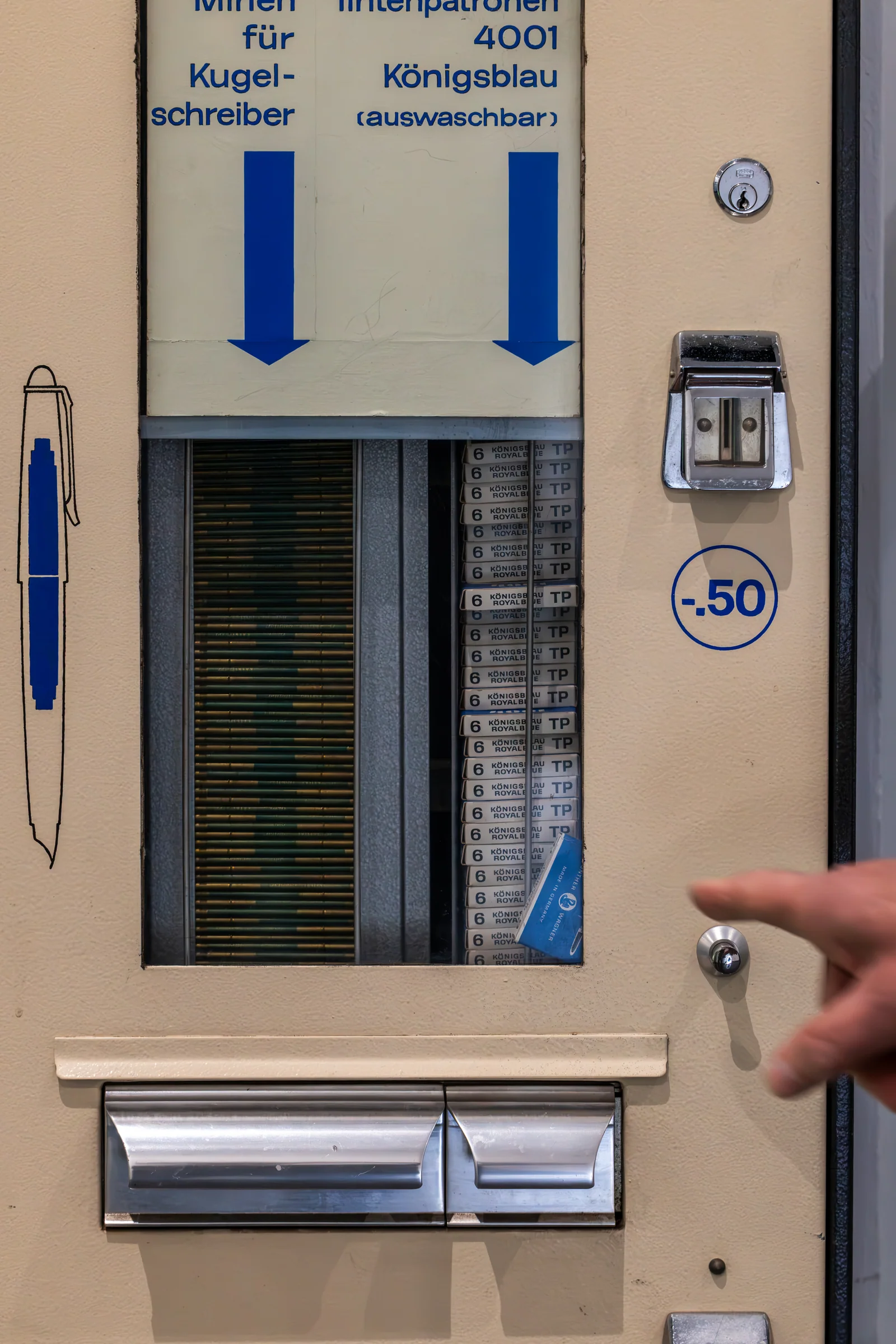
The ink tablets caught my attention, too. This dry form could be mixed with water to make ink. At a time when enthusiasts discuss shades and the design of glass bottles, it is interesting to see the many different ways people once solved the everyday problem of keeping themselves supplied for writing.
The 4001 range has a special place in this story. Its designation is documented as early as 1897. That little bottle on the desk therefore connects to a history reaching far back before the first Pelikan fountain pen.
Another familiar name appeared in the story of the packaging: Wilhelm Wagenfeld, the designer associated with the Bauhaus. He designed ink bottles for Pelikan, including the distinctive angled shape. There was a very practical reason for it. Tilting the bottle collected the remaining ink in the front recess, making it easier to use.
I like this kind of design. Its purpose becomes clear through use, when you reach the last ink at the bottom and can still fill your pen.
What Pelikan Has in Common with a Tin Can
At the time of our visit, the exhibition Weltverbesserer. Pelikans (un)bekannte Innovationen had just opened. It explored both familiar and less familiar innovations from the brand. Twenty-four selected exhibits showed how broadly the company had thought at different points in its history.
One of the biggest surprises was a tin can. In the 1950s, Pelikan developed a solution called the Ziehfixdose, which could be opened without a separate tool. It grew out of the manufacture of metal packaging and showed how a company could apply its experience beyond the field with which the public most strongly associated it.
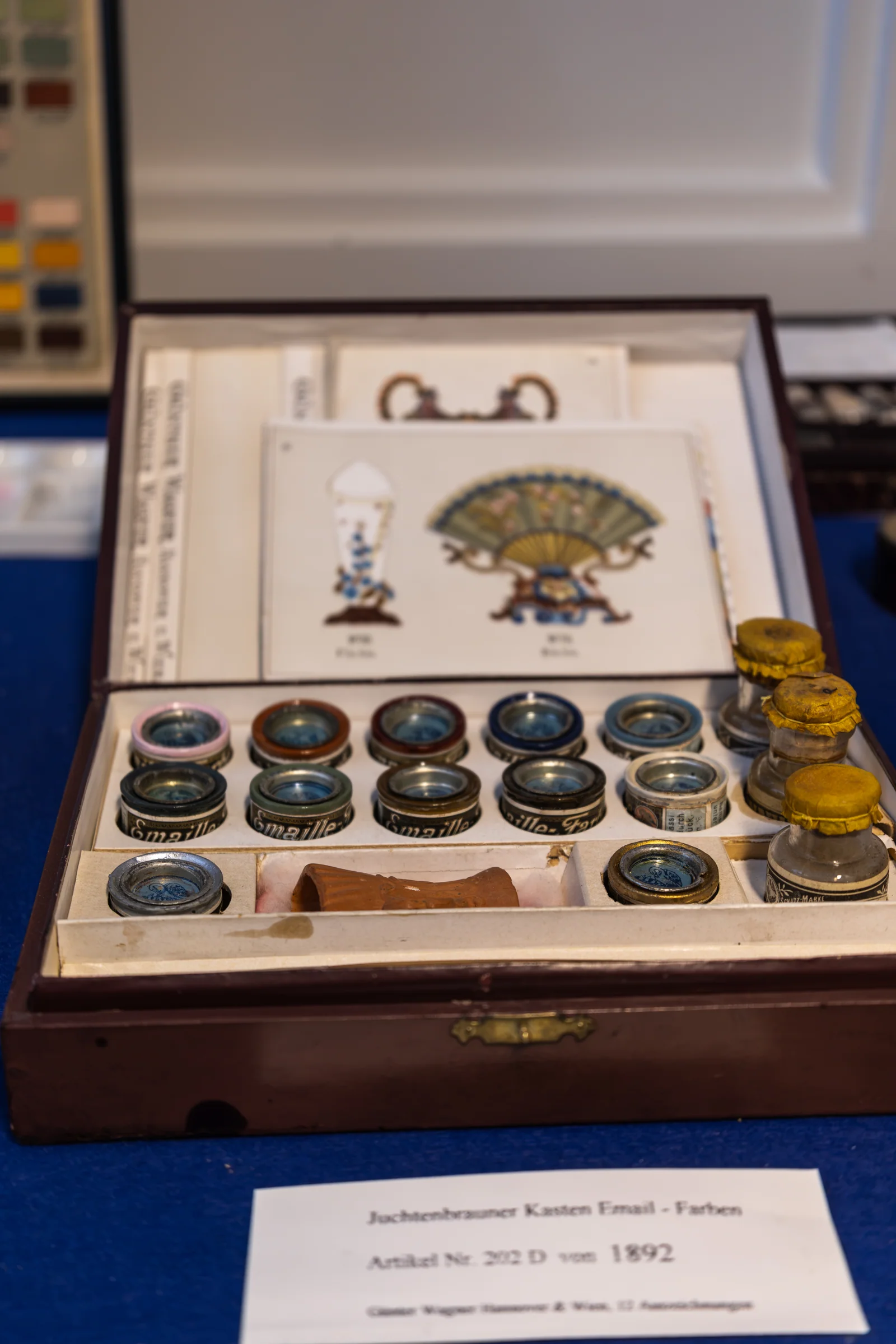
The displays also included office products, copying supplies, typewriter ribbons, school materials, and leisure products. The old manufacturing processes were interesting as well: ink poured into bottles by hand, and paint boxes into which women workers placed the individual colors one by one.
For many people, their first encounter with Pelikan comes at school. The Pelikano model was developed in 1960 through collaboration between designers and handwriting teachers. When looking at artistic editions costing thousands of euros, it is easy to forget this everyday side of the brand.
The history also includes experiments that did not succeed. One example is the Pelikan Level from 1996. It was filled through the back using a special bottle, in a way that resembled refilling a gas lighter. In its own history, the manufacturer openly acknowledges that customers did not take to the unfamiliar system, and production ended. Even a carefully designed technical innovation needs people who want to use it.
What Stayed with Me
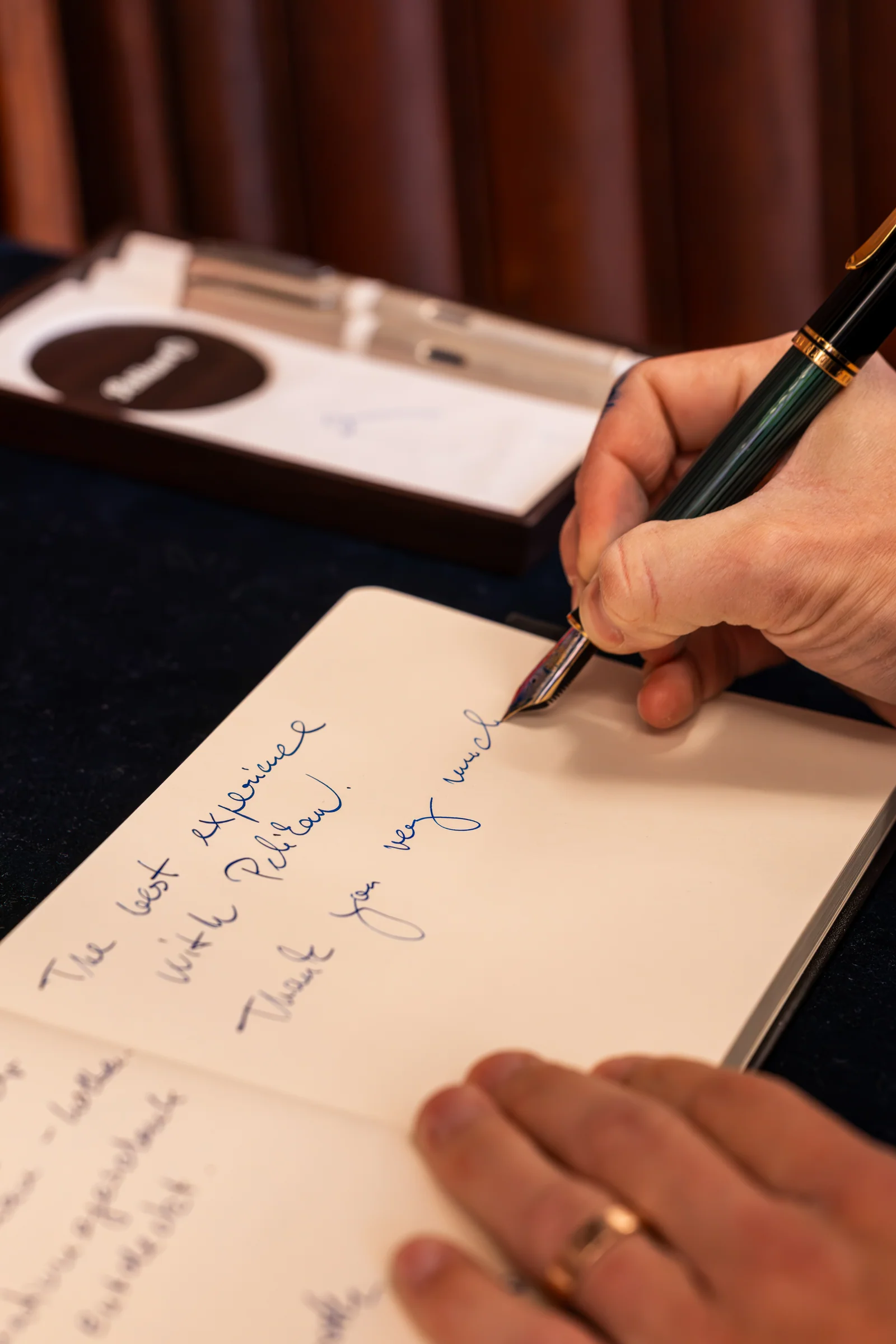
On trips like this, I am of course interested in the pens. I want to see historic models, details of the workmanship, and pieces that are not usually accessible. In Hanover, the memories of a particular person became part of that experience.
The archive was the sort of place where I could happily lose entire days. There were so many different materials, products, and little things to discover. My ideal visit would have involved opening every single drawer with Willi and listening to the story behind whatever we found.
What I like about Pelikan is how distinctive its whole visual world feels. The lettering, illustrations, colors, and objects have a character of their own. It does not feel like a brand chasing each new trend or trying to give everything a minimalist makeover. It follows its own direction, and I find that very appealing.
Willi’s Toledo, retired colleagues helping to revive production, ink tablets, and pelicans at the entrance all gave me new connections to think about. I really appreciated the time he spent with us and his willingness to talk about the small details that rarely make it into a brief company history.
Now, when I pick up my M805, I also think of the production processes and the people who had to master them. In the little logo, I see the story of Wagner’s family. And when I think of Hanover, I also picture Willi with his own Toledo.
It is for connections like these that I want to continue On the Road. Back at my desk at home, a pen then comes with the memory of a person, a conversation, and a place I had the chance to get to know.

If You Would Like to Visit the TintenTurm
You will find the Pelikan TintenTurm at Pelikanplatz 21 in Hanover. Admission to the exhibition is free; guided historical tours have their own arrangements and are worth booking in advance. Before traveling, check the current opening hours on the official TintenTurm website, especially if you only have a short stop in the city. It is usually closed on Mondays.

The Journey Continues

After Faber-Castell in Stein and Pelikan in Hanover, our On the Road journey continues towards Hamburg. There are more people to meet, more places to discover, and more stories to bring back to the writing desk.
For the full story of the trip and the people behind it, read On the Road – The Stories Behind the Pens.
Read next

On the Road – The Stories Behind the Pens
Six days in Germany, from Faber-Castell and Pelikan to independent workshops and Montblanc: the people, discoveries and personal moments behind On the Road.
Read article
Inside Faber-Castell in Stein: The Surprising Life of a Pencil
A factory visit in Stein, from graphite and clay to eight coats of lacquer, an eraser without glue and a fountain pen made from 84 pieces of wood.
Read article
Inside &Liebe: The Japanese Craft Behind Leather Pen Cases
When I see “Made in Japan” somewhere, it immediately has my full attention. I love Japanese culture, its people, and of course the products — which are often made in a way that feels very different from what we are used to outside Japan. One of my favourite brands is andliebe, and I would like..
Read article
0 comments
Comments are moderated before publishing, so the conversation stays useful and calm.
No comments yet. You can leave the first note below.