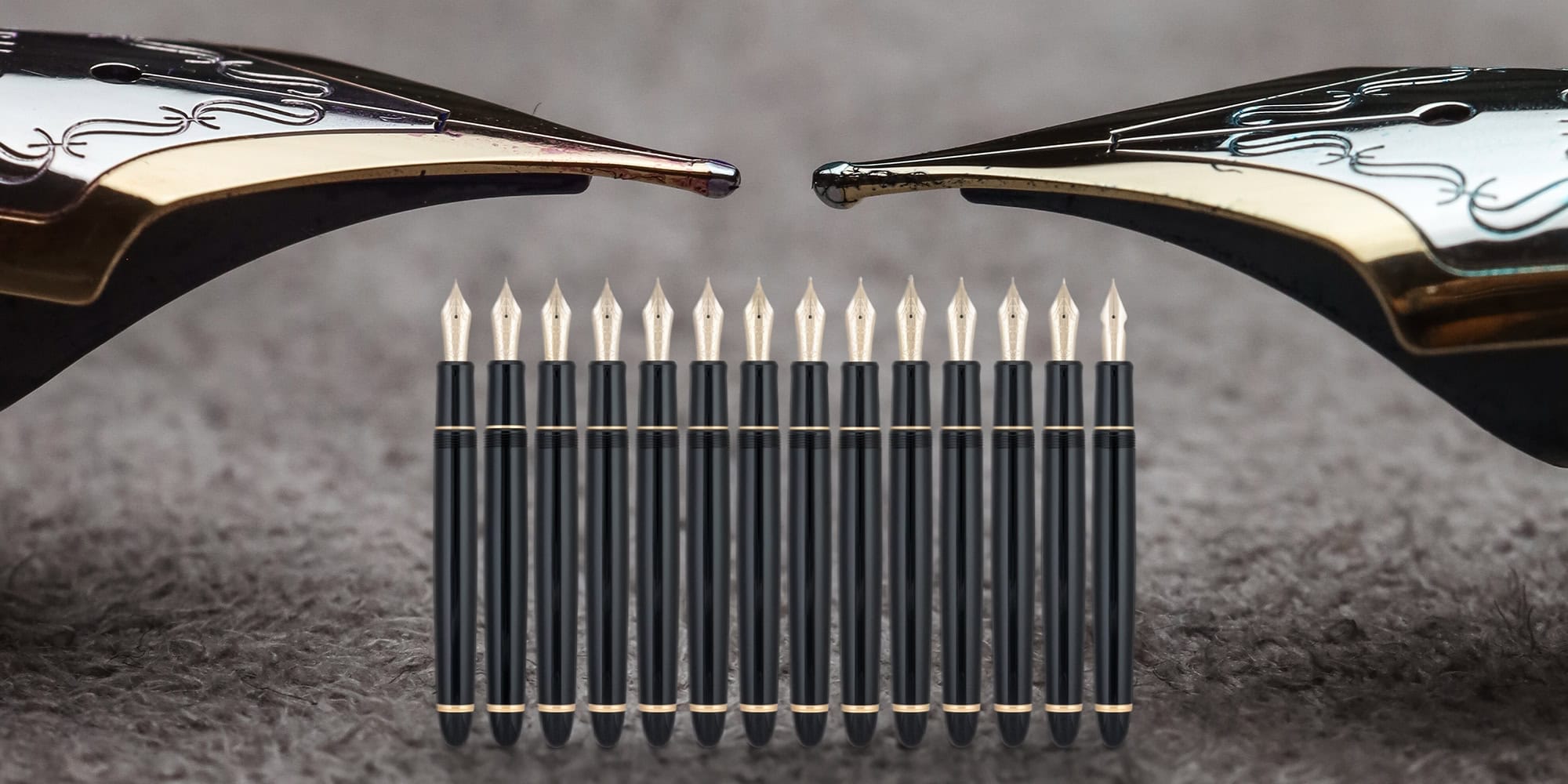
If you’ve ever wondered why a Pilot pen can feel completely different from anything else on the market, the answer is here—in the nib. If you are someone who truly writes with your pens—not just collects them—then Pilot is a dream come true. The sheer variety of nibs they offer is remarkable, especially considering they are available without extra cost and without long waiting times. Personally, I find this absolutely fascinating. One of my collector goals is to own every available nib option, so I can choose between them depending on my mood or the purpose. Here, you’ll find a complete overview of all currently available nibs, along with my recommendations on how they perform and what they are best suited for.
This guide walks through every major Pilot nib, not as a checklist, but as a real-world exploration of how they behave on paper, who they are for, and when they make sense.
Understanding Pilot’s Philosophy
Before diving into individual nibs, it’s important to understand what sets Pilot apart.
Japanese nibs are generally finer than Western ones, but that’s only the surface. Pilot designs nibs with intentional control over feedback, ink flow, elasticity, and writing angle. That’s why two nibs of the same size can feel completely different.
More importantly, Pilot acknowledges that writing is not one thing. Some people write small and precise. Others write fast and fluid. Some want expression. Others want discipline.
EF – Precision Above All 

The Extra Fine nib is not designed to impress—it is designed to perform. It produces an extremely thin, controlled line that excels in situations where space is limited or clarity is critical. Writing with an EF nib feels deliberate. There is noticeable feedback, almost pencil-like, which actually helps maintain control.
This nib is ideal for people who write small, annotate documents, or work with structured layouts like planners. It also performs exceptionally well on lower-quality paper, where broader nibs would feather or bleed.
However, EF is not about beauty. Ink shading is minimal, and the writing lacks visual drama. If your goal is expression, this is not your tool. But if your goal is precision, nothing comes close.
F – The Practical Standard

The Fine nib is where usability and comfort meet. It retains much of the precision of EF but introduces a slightly smoother experience and a more visible line.
For many people, this is the ideal everyday nib. It handles most papers well, keeps handwriting legible, and doesn’t demand adaptation. It’s also the safest choice if you are unsure where to start.
That said, it still leans toward functionality rather than character. It writes well, but it won’t transform your handwriting.
FM – The Hidden Sweet Spot

The Fine Medium nib is often overlooked, but it may be one of the most intelligently balanced nibs Pilot offers. It softens the sharpness of a Fine nib while maintaining a controlled line width.
What makes FM special is how it enhances the writing experience without sacrificing usability. Ink begins to show more shading. The pen glides more smoothly. Long writing sessions become noticeably more comfortable.
For users who find Fine too restrictive and Medium too broad, FM is often the answer they didn’t know they needed.
M – Where Writing Becomes Enjoyable

The Medium nib is where the writing experience shifts from functional to enjoyable. It introduces a generous ink flow, smoother movement, and visible ink character.
With an M nib, shading, saturation, and color variation begin to appear. Writing feels effortless, almost gliding across the page.
The trade-off is precision. If you write small or use cheap paper, you may lose control. But if your goal is comfort and visual richness, this is where Pilot starts to shine.
B (Broad) – Controlled Boldness

The Broad nib is where writing stops being purely functional and starts becoming visually engaging. The line is wide enough to reveal the true character of an ink—shading, saturation, and subtle tonal variation—while still remaining reasonably controlled.
In use, a B nib feels exceptionally smooth. Ink flow is generous, the pen glides effortlessly across the page, and the overall experience becomes noticeably more comfortable compared to finer nibs. Yet it doesn’t completely lose discipline—you can still use it for regular writing, as long as your handwriting isn’t too small.
For many users, this is the first real “wow moment,” when ink finally starts to look alive on paper.
The Broad nib is particularly well suited for longer writing sessions, journaling, and exploring inks in a more expressive way. It also works beautifully for signatures, where a slightly bolder line adds presence without becoming overwhelming.
Its main limitation is practicality. It requires better paper to perform well, and on lower-quality paper it can feather or bleed. It is also less suited for compact writing or detailed notes.
BB (Double Broad) – Maximum Expression

The BB nib takes everything the Broad nib offers and pushes it further—sometimes to the edge of practicality.
This is no longer just a bold line; it is a statement. The ink flow is heavy, the strokes are wide, and the visual impact is immediate. Shading becomes dramatic, and certain inks can reveal layers of depth that simply don’t appear with finer nibs.
Writing with a BB nib feels almost indulgent. The pen glides with minimal resistance, laying down a rich, saturated line that demands attention. However, this comes at a cost.
Control is reduced, and the nib quickly becomes impractical for everyday writing. Small handwriting becomes difficult, and paper quality becomes critical. On anything less than high-quality paper, issues like feathering and bleed-through are almost guaranteed.
The BB nib is best understood not as a daily tool, but as a specialist. It excels in situations where visual impact matters—large handwriting, signatures, headings, or simply enjoying the full potential of an ink.
For enthusiasts, it offers one of the most immersive writing experiences available. For practical use, it requires compromise.
PO – Extreme Control

The Posting nib is one of the most specialized modern nibs you can get. Its slightly downward-bent tip is engineered to maintain an extremely fine line even when writing at a lower angle—something traditional nibs struggle with.
In practice, the PO nib feels firm, controlled, and highly disciplined. It produces an exceptionally thin line, often even finer than a standard Extra Fine, while maintaining consistency across different papers.
This is not a nib designed for comfort or expression. It is designed for accuracy. It excels in situations where clarity and space matter—annotations, structured writing, or working with poor-quality paper.
For many users, it may feel too rigid or too sharp. But for those who value precision above all else, the PO nib becomes almost irreplaceable. I absolutely love my PO nib and wouldn’t trade it for anything.
FA (Falcon) – Controlled Flexibility

The Falcon nib introduces a completely different writing dynamic. Unlike standard nibs, it responds to pressure, allowing the line to widen and narrow depending on how you write.
However, it is important to set expectations correctly—this is not vintage flex. The FA nib offers controlled elasticity rather than dramatic, effortless line variation.
When used properly, it creates expressive strokes and adds personality to writing. But it requires a lighter touch, better ink flow, and often a feed that can keep up with the increased demand.
This nib is best suited for experienced users who want to explore expressive writing without stepping into unpredictable vintage territory.
WA (Waverly) – Effortless Adaptability

At first glance, the Waverly nib looks subtle. Its slightly upturned tip doesn’t seem like a major change—but in practice, it transforms how the pen behaves.
The WA nib is incredibly forgiving. It writes smoothly across a wide range of angles, making it ideal for users who rotate their pen, change grip, or simply want a stress-free writing experience.
There is no line variation or dramatic character here. Instead, the value lies in consistency and ease. It’s a nib that adapts to you, rather than forcing you to adapt to it.
For long writing sessions or casual everyday use, it is one of the most comfortable options Pilot offers.
SU (Stub) – Instant Character

The Stub nib changes the way your handwriting looks immediately. Its flat tip creates natural line variation—broad vertical strokes and thinner horizontal ones—without requiring pressure.
This makes it one of the most accessible ways to introduce character into your writing. Even simple handwriting starts to look more structured and visually appealing.
However, the SU nib requires consistency in angle. If you rotate the pen too much, the line can become uneven or lose its definition.
It’s an excellent choice for headings, journaling, and decorative writing—but less suited for fast, careless note-taking.
C (Coarse) – Pure Ink Presence

The Coarse nib is unapologetically bold. It delivers a wide, heavily saturated line with significant ink flow, designed to maximize visual impact.
Writing with a C nib feels smooth and effortless, but also very wet. It brings out strong shading and can reveal complex ink properties that finer nibs simply cannot show.
At the same time, it quickly becomes impractical for everyday writing. It demands high-quality paper and a larger handwriting style.
This is a nib for those who want to experience ink at its fullest—not for those seeking precision.
MS (Music) – Structured Expression

The Music nib is one of the most unique tools in Pilot’s lineup. With three tines instead of two, it delivers a combination of heavy ink flow and structured line variation.
Originally designed for writing musical notation, it produces broad vertical strokes and thinner horizontal ones, similar to a stub—but with much more ink.
The result is highly expressive, almost brush-like writing. It excels in calligraphy, artistic writing, and situations where visual impact is more important than control.
However, it is not a practical everyday nib. It requires proper paper, a slower writing pace, and a willingness to adapt your technique.
Signature (S) – Effortless Line Variation
The Signature nib (often marked as “S”) is one of Pilot’s most underrated and least discussed nibs—yet in practice, it offers a surprisingly unique writing experience.
At first glance, it may seem similar to a broad or medium nib, but its defining characteristic lies in the way it subtly shapes the line. Unlike a stub or music nib, the Signature nib does not rely on sharp edges or strict angles. Instead, it produces a naturally varied line depending on the direction of your stroke and the way you move across the page.
Writing with a Signature nib feels smooth and fluid, with a generous ink flow that allows the pen to glide effortlessly. The line has more presence than a typical medium, but without the demanding technique of a stub. It introduces character into your handwriting without forcing you to change how you write.
This makes it an excellent choice for those who want expressive writing without complexity. You don’t need to think about angles or pressure—variation happens organically.
However, this also means the effect is more subtle. If you are expecting dramatic calligraphic contrast, you may find it too restrained. And like most broader nibs, it performs best on higher-quality paper where the ink can fully develop.
The Signature nib sits in a very specific space:
- not technical like PO,
- not flexible like FA,
- not structured like SU — but naturally expressive in a way that feels effortless.
For many, it becomes a hidden favorite—the kind of nib you don’t fully appreciate until you spend time with it.
SF (Soft Fine) – Subtle Expression

The Soft Fine nib introduces a gentle bounce into an otherwise precise line. It retains the control of a Fine nib but adds a layer of responsiveness.
You won’t get dramatic line variation here, but you will feel the difference. Writing becomes more organic, less rigid.
This is an excellent choice for users who want a bit of character without sacrificing precision.
SFM (Soft Fine Medium) – The Balance Point

If there is one nib that balances everything—this is it. The SFM offers enough width to show ink character, enough softness to feel alive, and enough control to remain practical.
It is one of the most versatile nibs Pilot produces. Whether you are journaling, writing letters, or simply enjoying the act of writing, it adapts effortlessly. For many users, this becomes the “endgame” nib.
SM (Soft Medium) – Smooth Expression

The Soft Medium nib leans fully into comfort and flow. It combines a wider line with a soft, cushioned feel that makes writing almost effortless. Ink flow is generous, shading is visible, and the overall experience becomes immersive. It’s a nib that encourages slower, more intentional writing.
The trade-off is precision. It’s less suited for small handwriting or structured notes, but excellent for expressive writing and longer sessions.
Pilot Nib Comparison
Quick overview of how each nib actually behaves in real writing
| Nib | Line | Feel | Flow | Expression | Angle | Best use | Limitations |
|---|---|---|---|---|---|---|---|
| EF | Ultra fine | Feedback | Low | Minimal | Medium | Small writing, notes | Not smooth, low shading |
| F | Fine | Controlled | Medium | Low | Medium | Everyday writing | Limited character |
| FM | Fine–Medium | Smoother | Medium | Medium | Medium | Balanced writing | Less precise than F |
| M | Medium | Very smooth | High | Medium–High | Medium | Journaling, letters | Needs better paper |
| B | Broad | Smooth | High | High | Medium | Ink testing, signatures | Not for small writing |
| BB | Very broad | Ultra smooth | Very high | Very high | Low | Showcase writing | Low control, paper sensitive |
| S | Broad+ | Very smooth | High | High (natural) | Medium | Expressive everyday writing | Subtle variation, not crisp like stub |
| PO | Ultra fine | Firm | Low | Minimal | High | Precise work | Not expressive |
| FA | Variable | Soft | High | Very high | Low | Expressive writing | Requires control |
| WA | Medium | Smooth | Medium | Low | Very high | Everyday comfort | No variation |
| SU | Stub | Smooth edge | Medium | High | Low | Calligraphy | Angle sensitive |
| C | Very broad | Smooth | Very high | High | Medium | Bold writing | Impractical daily |
| MS | Variable | Wet | Very high | Very high | Low | Calligraphy | Not for everyday |
| SF | Fine | Soft | Medium | Medium | Medium | Controlled expression | Subtle variation only |
| SFM | Fine–Medium | Soft smooth | Medium | Medium–High | Medium | All-rounder | None significant |
| SM | Medium | Soft | High | High | Medium | Expressive writing | Less precise |
These are the nibs currently available for Pilot fountain pens. It’s a pleasure to be able to choose from such a diverse portfolio. There is only one thing I find missing: they are not available in all sizes across all Pilot models. For example, if you choose a Custom Urushi, you are limited to the standard nib sizes—you can’t get the more specialized nib options with it.
3 Comments:
Darrell Says: on 1. March 2026
Recently new to Pilot pens (if not fountain pens in general) and looking for something for all-around use and, in particular, cursive writing. I find the Pilot Custom 823, with (oddly enough) a fine nib, to be perfect for block lettering when note taking. But looking for something a little smoother, more expressive and easier for more cursive writing. I may have to explore the SFM nib. Thanks for taking the time to put this out there.
Richard Walters Says: on 1. March 2026
It was only today that I learned that Pilot’s EF nibs are not all the same.
PILOT EF NIBS RANKED (THINNEST → THICKEST)
Estimated Line Widths in Millimeters
Pilot Penmanship EF — 0.18–0.20 mm
Thinnest Pilot makes; very dry, crisp, needle‑fine.
Pilot Kakuno EF — 0.20–0.22 mm
Slightly wetter and smoother than Penmanship.
Pilot Metropolitan EF — 0.22–0.24 mm
Same nib as Penmanship/Kakuno but with a wetter feed.
Pilot Prera EF — 0.23–0.25 mm
Smoothest steel EF; slightly thicker due to feed tuning.
Pilot 78G+ EF — 0.23–0.26 mm
Classic steel EF; similar to Metro/Prera.
Pilot Custom 742 EF — 0.26–0.28 mm
Gold #10 nib; wetter, rounder, thicker line.
Pilot Custom 912 EF — 0.27–0.29 mm
Same #10 nib as 742; slightly wetter.
Pilot Custom 823 EF — 0.30–0.33 mm
Gold #15 nib; wettest EF Pilot makes; thickest EF line.
filip Says: on 1. March 2026
Oh wow, thank you for writing this here, I really appreciate it. I had no idea. That’s very interesting.